


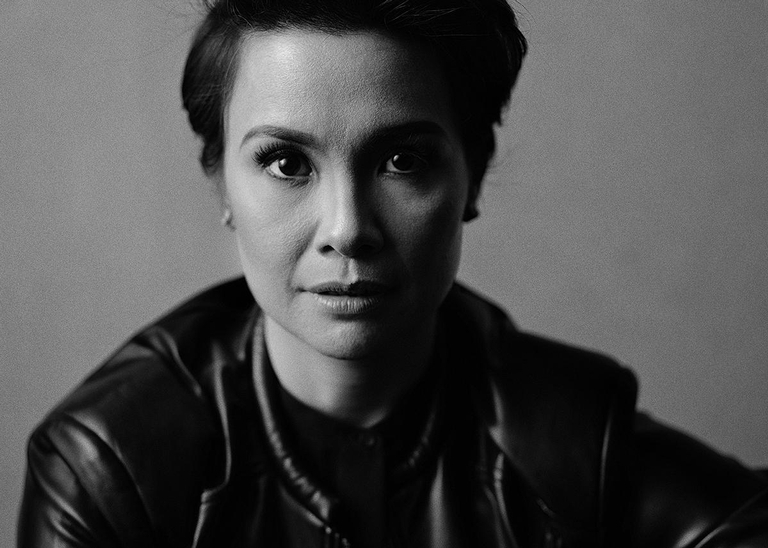

Manila (CNN Philippines Life) — When Lea Salonga was one of the judges of the Miss Universe 2011, it was her who asked the final question for the winning candidate, Leila Lopes of Angola. However implausible it may seem, it was enough to link the Tony-award winning Broadway actress to Lopes’s victory that year.
“People were telling me, ‘You made her win!’,” she recalls while laughing on the set of CNN Philippines’ The Source, where she recounted her experience in São Paulo, Brazil that year. Lopes would of course go on to be one of the judges in this year’s Miss Universe, which was held in the Philippines — Salonga’s home country.
Salonga was quick to point out that judging the candidates during the event itself is very different from just watching it at home. “As somebody who just watched from home — whether I’m like an armchair judge or ‘under my comforter in my pajamas’ kind of a judge at home — you tend to look for this, whatever your vision of beauty is,” she says. “But once you’re actually sitting in that chair and you’re looking at those girls from unflattering angles, you start to be very picky about things.”
A Miss Universe judge has to look at all the girls and base their decision on how a candidate is, as Salonga puts it, “more than the sum of her parts.”
“When you see her intelligence and her charm, and how dignified she carries herself, and her confidence and poise — when you factor all of that in with the physical beauty … then it kinda adds points. The more poised someone is under all that pressure, that they are still able to handle that,” she says.

After talking to The Source’s host Pinky Webb, Salonga sat down with CNN Philippines Life to talk about the things that go through a judge’s head while watching the pageant on stage, how they were briefed, and the similarities between the pageant and the theater stage. Below are edited excerpts from the interview.
Did you guys get a chance to mingle with the candidates before the actual pageant?
No. They purposely kept the candidates away from the judges. And the first time we see them is when they first appear [on stage]. We don’t see websites, I think we were encouraged not to look at anything [on the girls]. So we judge based on how we see. Not on how they do in the preliminary rounds, we judge them on [the final] round only. That’s it. It’s fair and everyone starts off pretty much equal. But actually, our work starts when the first set is called. When the first cut is made. And you’re looking at everything? How does this swimsuit look on her? Is it flattering? How is she walking? Does she look comfortable? Did she spend time at the gym? Is there surgical enhancement? Does she look too perfect? Is this a Barbie doll or is this a human being? — There’s all that. All of those things end up in your mind.
So you’re actually looking at each girl or just the ones that stand out for you?
You have to look at each one. This is even before they open their mouths to speak. They’re just walking on stage and you look at how they walk, how they’re posing, how confident they are. And a lot of them look like they really spent time at the gym in order to look that great. And these ladies take it seriously.
How were you guys briefed on how to judge the candidates?
All of the judges were put together and briefed as to what to look for, how the scoring works, how to place the candidates that you like, and then all of that is taken into account. You can’t look at the person next to you, you judge based on what you think.
One of the interesting things that you said during your interview with Pinky Webb was language as another obstacle to overcome by the girls for whom English is not their first language….
You want them to come across as confident and eloquent, and know exactly what they’re saying. Kasi kung matutumba ka lang, and if English is going to be your downfall, why are you gonna [take that risk]? You have to show each girl at their best. And if her best includes an interpreter, you get an interpreter for her. I think all these women are able to communicate, to some degree, in English. That’s how they become friends, go shopping, order in restaurants … there’s enough proficiency for basic conversation. And under no pressure it’s okay to be grammatically incorrect. But on that stage? You really want to take that risk?
The lady who won the year I judged, [Miss Angola], was a student in the UK. So you can assume that her English is really good already. But why did she ask for an interpreter at the pageant? This is already someone whom you think is academically proficient and speaks English like a boss. So why? I think she is more able to eloquently and confidently express herself in her native language. Because there are things in your native language that are hard to express.
If you’re bilingual, if you speak both Tagalog and English proficiently, you understand that there are things that are so difficult to express in one language compared to the other. I know this firsthand. And there are ways in which I can express better in one language. There are ways in which I can express myself better in another.
Do you see parallels between musical theater and beauty pageants?
Everybody has to be on point. When all of the eyes on that theater are on you, and even if things are not going well, behind the scenes, the audience cannot know at all. Whatever happens backstage, [even] if it’s absolute chaos, the audience should not see that.