


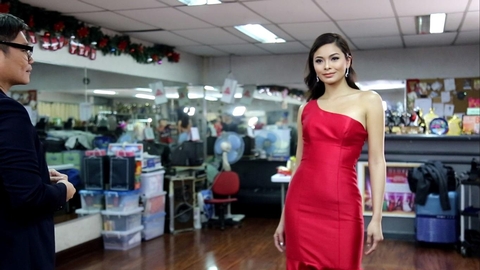
Manila (CNN Philippines Life) — Jonas Gaffud knows beauty when he sees it, and what he sees is more than skin-deep.
He saw it in Janine Tugonon, Shamcey Supsup, Venus Raj, and later on, Pia Wurtzbach. He saw the same potential that he sees in Maxine Medina, the Philippine candidate for this year’s Miss Universe. On January 30, the coronation day of Miss Universe 2016, he wishes to see another one of his alagas make it to the final stages of the competition.
“What strikes me is how classy women can be, it’s the aura that I [see] in them,” Gaffud says.
Gaffud heads Aces & Queens, a training camp for aspiring beauty queens. He gets no pay from this venture; he does so in the service of the beauty and talent that they find. Gaffud recalls that the agency used to scout for girls, making use of connections in the modeling world. After 2010, when Venus Raj made it to the top 5 of the Miss Universe competition, Gaffud says girls have been approaching them. They want to be beauty queens.
Lately, it appears that beauty also crucially lies in the words one says. Having just a pretty face may not work when under the scrutiny of Miss Universe organizers, whom Gaffud says look for a complete package.

No beauty in mediocrity
To be the complete package takes a lot of training, and queens are told to steel themselves emotionally in order to handle the pressure that comes with competing in any beauty pageant.
“I don’t believe in mediocrity,” says Gaffud. “We’re trying to make the girls more engaging, powerful, so they know what to do and what to say [onstage and] in public.” Achieving this takes training on many fronts; beauty queens have to know the proper walk and looks suited for their built, they have to keep healthy, and they have to be smart.
Quite simply, maintaining good physical health and runway walks are easily perfected through dedication. Show up for trainings. Never use an invalid excuse for underperformance. These are all Nad Bronce — who works with Gaffud — asks from his trainees.
A Q&A trainer like Bronce does not believe in formula. As a long-time pageant enthusiast and trainer, he has seen pageant trends as they ebbed and flowed. They anticipate this degree of unpredictability by developing good trainer-contestant dynamic and comprehensive training sessions.

On Bronce’s part, he holds Q&A trainings with a classroom type set-up. Beauty queens are seated as classmates, Bronce asks possible questions, trainees answer, comment, and give each other suggestions. Bronce fondly recalls that the reigning Miss Universe, Pia Wurtzbach, was his star student.
“Si Pia, palagi siyang nagtataas ng kamay, giving alternative answers. Ganoon siyang kapursigido (Pia always raises her hand, giving alternative answers. She’s that determined),” he says of Wurtzbach. She kept three notebooks filled with points from his classes. She would use it even after her crowning as Miss Universe, Bronce fondly shares.
But what constitutes as smart in Miss Universe and in the world of beauty pageants may be a bit more challenging to pin down. Pageant judges and enthusiasts seem to have an eye for the perfect combination of wits and beauty. For most, cracking the code is crucial as all pageants culminate in the Q&A segment.

No beauty in Filipino?
Historically, the metric of intelligence for the Filipino audience is mediated by language.
“[Answering in English] has to do with Filipinos trying to project a global image through the English language, this entitlement to cosmopolitanism, to a career out there in New York,” says J. Pilapil Jacobo, a Filipino instructor at the Ateneo De Manila University and long-time beauty pageant enthusiast.
“The standard of intelligence here in bourgeois Philippines is Anglophony, [and] it’s an attitude that can be attributed to colonialism,” he adds. Maxine Medina, the country’s bet this year, was recently criticized for not being able to express herself in English at her send-off party on January 10.
For the Filipino audience, confidence and authenticity are not enough. One must have eloquence in the English language too.
“Intelligence and language acquisition, or eloquence [in a particular language], are not mutually exclusive,” Jacobo emphasizes. “[If Maxine succeeds in answering in Filipino] it’s a postcolonial point — that finally, Filipinos can be confident, be beautiful, in their own language,” Jacobo believes. He saw partial triumph in 1994 Miss Universe Sushmita Sen, who articulated her answer in a kind of English only Indians speak.
Jacobo here refers to Hinglish. “Her English is an English mediated by Hindu philosophy, the kind of thinking that can only be born and raised in New Delhi, for example.”
But the ultimate hope is to be able to show the Filipina’s wit in Filipino. Jacobo is hopeful and certainly would like to see the country’s Miss Universe representatives use our language soon — even if the organizers and the audience of the pageant remain Anglophonic.
“[Maxine] is a Filipina and I don’t think it will make her less of a beauty queen if she will decide to use our language on the grand coronation,” believes Gloria Diaz, Miss Universe 1969. She also wishes that contestants not forget to enjoy themselves.
But Medina has big shoes to fill, competing the year after Wurtzbach was crowned. Preparation is key, says Margie Moran, Miss Universe 1973. And preparation goes beyond physical training; a future Miss Universe must be well-read, Moran believes. “You must know what’s happening in the world.”