



Manila (CNN Philippines Life) — Chef Mark Tan is a prolific speaker, as he is a chef. His words — like his food — speak volumes. We are at Hibana, his newest restaurant concept in Legaspi Village, Makati City (where the former Allium once stood), feasting on everything we decided to order in their tentative menu.
We started with the prawn cracker with uni dip. Pro tip: Watch out for the tangy zest at the end. “I’ve ordered that four times myself,” laughs communication consultant Joey Suarez, as we gushed about the starter. He tells us the cracker was made in the kitchen, as most things in Hibana are.
The prawn cracker with uni dip, as simple and as straightforward as it looks, is representative of Hibana’s philosophy. What the restaurant tries to do, says Tan, is “to source good product, making it as relatable and as reasonably priced as possible for everyday diners.” He says “good product” around five times every minute, and it manifests in Hibana’s food: in the subtle yellowfin tuna tataki, sweetened with Asian pear and pickled shimeji mushrooms; in the gleaming cubes of wagyu beef saikoro, a potential runaway bestseller; in the hamachi kama with chili ponzu, rivaling the best of our grilled fish panga; in the four kinds of smoky kushiyaki; and in his unagi roll with avocado, nitsume, and broiled eel — among many others. Most of the seafood is even sourced from Tokyo’s Tsukiji market.

And then there’s dessert: the Kyoto miso souffle is as delicately flavorful as it is light, the soy sauce ice cream dances around in your tongue, as the shell of the red bean mochi tenderly embraces it.
There is little that could go wrong with the food in Hibana, the experience of which is heightened with a selection of drinks conceptualized with The Curator’s Jericson Co. “The food nourishes, as the drinks entertain,” he tells us, as he takes us through the initial cocktail menu. As of now, there are four requisite classics — a negroni, daiquiri, old fashioned, and midori sour — and four “twists” in the forms of the damigella, black sesame sour, ember tonic, and hi ball. The damigella is best paired with richer food; the black sesame sour, a refreshing palate cleanser; the ember tonic for the grilled and smoked meats; and the hi ball for sushi and raw food. Non-alcoholic pairing options are also being developed, says Co.
If the pairings work, it’s because Co and Tan had previous experience working before, matching food and drink together. And if the food in Hibana works, it’s because Tan cares enough about Japanese cuisine to know how to respect the ingredients and get creative with them at the same time. In between bites of Kyoto miso souffle, CNN Philippines Life sat with Mark Tan, as he situates Hibana in the Japanese dining experience. Below are edited excerpts from the interview.

What’s Hibana all about?
We take traditional Japanese food as inspiration, and then we look at the products we have, the specific ways of cooking we want to [do], like cooking with charcoal — something we really want to emphasize — and then we run from there. You try to make it as straightforward, as simple as possible. The main goal is we don’t want people to come and think about the food so much. That’s why we try to make the plating as simple as [we can].
I noticed here from doing fine dining before, the plates might look pretty, but if the diner takes, like, 10 minutes to eat, then your intent for the dish isn’t there anymore. We’re already wasting time getting it from the kitchen, so if they have to take pictures or analyze how this was made, things of that nature… sometimes some diners, when they’ve had bad experiences in fine dining restaurants, part of it is because they took too long to eat. The intent for the dish changes so much. That’s why a lot of fining dining restaurants, they don’t allow cameras or whatnot.
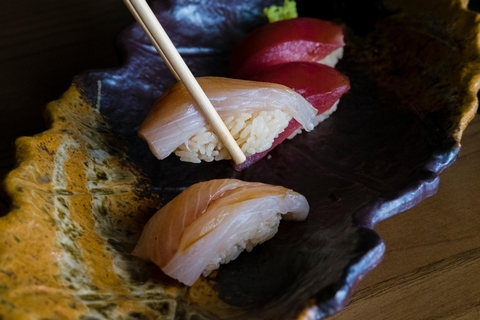
So it’s taking that idea, inspired by traditional sushi restaurants where you sit at the counter, the reason being … you know in Japan, they’re very specialized, there’s tempura bars, sushi bars, yakitori places and they’re all bars. Part of the intent, when they serve you piece by piece, is that once it’s done and ready, it’s placed in front of you, and you consume it. That’s one of the reasons we simplify everything, so they see it, it looks good to them, and they eat. We want to eliminate a lot more of the other things that people do when they dine out, so they can enjoy food.

We’re using Japanese food as the inspiration. That’s partly what got me into cooking. When I first moved into the U.S., I was exposed to sushi, not really good sushi, but I grew a taste for it. And one of the reasons I started cooking was I wanted to make sushi at home, ‘cause when you’re still in school, you can’t afford to eat sushi all the time, it’s very expensive. Then I started learning other cuisines. After I went to different culinary schools, I was fortunate to start working for people who were doing French cooking or Spanish food. But now we’re going back to what I wanted to do in the first place, and now there’s better products coming into the Philippines that makes it easier.
We have access to better fish, better meats, so now we can really make Japanese food properly. ‘Cause if you go to Japan, the food is simple. What makes it good are the products are good. If you don’t have good products, you can’t do Japanese food, because it’s as simple as you can get. It’s like the complete opposite of French cooking or modern Western cooking, where restaurant cooking is layering flavors, there’s a lot of process. In Japanese cuisine, a lot of process has already been done before you even use the product.
An example … when we do the tasting, we use what they call the honkarebushi, which is the dried bonito [fish] blocks that we shape ourselves in the kitchen. That’s like, five years in the making. So they’ve already put in all the work before you even start making your broth, your dashi … as opposed to a French kitchen or a Western kitchen where they try to get the complexity of the flavors inside.

Does the simplicity of Japanese cuisine limit your cooking in any way?
Not necessarily. Maybe I’m lucky that I’m not Japanese, ‘cause if I am and I trained in Japan, and I was very traditional, then you would have this limitation built in, where you want to stay very true. But being not Japanese, even though I’ve worked for very traditional Japanese chefs in the past, it doesn’t limit the way I think. So I’m open to using different products that they may not necessarily use for traditional Japanese food.
I wouldn’t say we’re traditional Japanese. If there’s a dish, we try to stay true to what it is traditionally, we just try to execute. But other parts of the menu are very open. We use iberico, we might use a ham from Spain for something, and still cook and present it in a Japanese manner, so in that regard I find it’s better. You can be more creative even as you want to make things simple. In that sense, we’re not limited.
A lot of Japanese chefs that are really within that box of being strict, traditional, it’s either they’re in Japan, or they’re in a city that has unlimited access to product of high quality. Those are the things that you would need to stay true [to traditional Japanese cuisine]. Even when you go to Japan, and you eat, a lot of the good restaurants are very good because their product is very good. Without the good product, it would be very hard for them to stay [true] … if you would put those chefs in a different country, they would have to adapt.

When you say good products, you mean good sources?
Good quality product as far as … in Japan, what they would consider mid-grade is already better than what’s considered first grade in a lot of other places. So their access to ingredients is just impeccable. That allows them to be simpler in preparation, but they still get that full flavor. A lot of it is they don’t really over-manipulate product.
Let’s say … Hokkaido has some of the best scallops in the world. You can go in any good restaurant in Japan, they would never cook that beyond rare — whether it’s seared scallop, whether it’s a tempura or whatnot. It’s usually barely cooked. They’re letting the product speak for itself, it’s still very sweet. When you cook it all the way through, not only is the texture bad but a lot of the flavor is gone. That’s what I meant, when they have good product, but they’re also smart enough not to do too much to it. That’s where simplicity in Japanese cuisine comes from.
And that’s what you’re trying to…
That’s what we’re aiming for. When we have good product, for whatever dish we try to do with it, we try to do the bare minimum necessary to do the dish, without necessarily over-manipulating. That’s the main focus of the restaurant … the core tenet when we cook and develop dishes.

Most everyday Japanese restaurants, they’re heavy on starch, like cornstarch for sauces. That’s something we don’t want to do. We still take Western ideas for that. We may use chicken, pork, or beef. We take 20 liters, and reduce that to a liter, that’s the base for our sauce, so we can get the body. That’s very non-Japanese, but the final sauce will taste very Japanese. But it allows us to make a sauce that has body, that has impact, without being heavy on a slurry for Chinese cooking, or like teriyaki sauce in general. When we do teriyaki, we don’t actually put sauce. We make a teriyaki marinade, we roast the product, for example a chicken, for a minute then take it out, then put it in our marinade, then put it back in … we do that for 10 times, until the flavors are fused. And then we can serve them without sauce, because the flavors are inside the whole product, as opposed to people slathering slurry and rich sauces. So we take that traditional technique, and then we take Western ideas and cooking, mix it up a little bit, and make it as simple as possible.
How much of a premium do you put on authenticity?
For me, we try to stay as authentic as possible to the process. Half of the menu you’re looking at right now can be considered authentic because … first, let’s say the iberico tonkatsu we’re making is not a traditional cut used for tonkatsu, is not a type of pork we use for tonkatsu, so that’s not authentic. But when we cook it, we want it to be as authentic as possible. When we make sushi, we’re going to have condiments that aren’t very authentic, but when we make our rice, the type of rice, the vinegar we [use] to make the sushi vinegar, the ageing of the vinegar … we’re using soy from the Yuasa Prefecture, we stock like six different varieties of soy, all grown and naturally fermented for a minimum of two or three years. And we use what they call white soy that’s all wheat, one tamari that’s all soy. We have a good mix. And we have some made from black beans. Those are very authentic products, but then the final result, what we use it for, might not be very authentic.
***
Hibana is located at G/F Grand Midori Condominium, Bolanos St., Legaspi Village, Makati. From Jan. 16 to 31, 2017, they are open for lunch from 11 a.m. to 3 p.m. Beginning February, Hibana will be open for both lunch and dinner, from 11 a.m. to 10 p.m.