


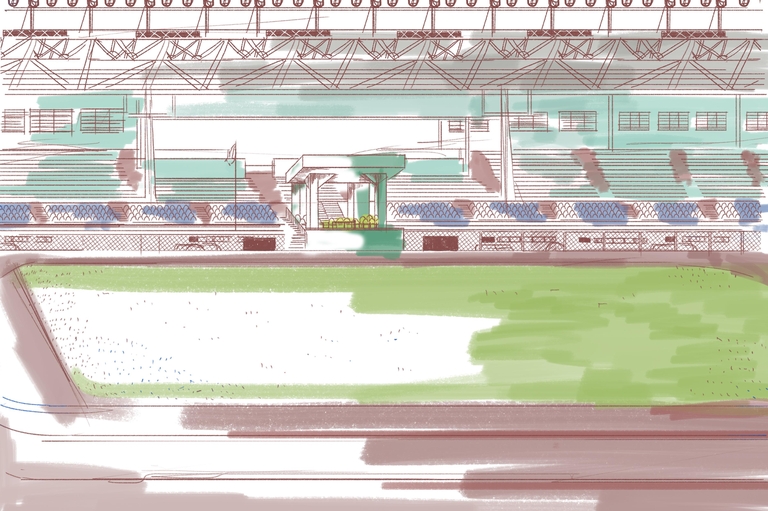
Manila (CNN Philippines Life) — Earlier this month, the City of Manila announced plans to redevelop and rehabilitate the historic Rizal Memorial Sports Complex (RMSC). There are reports that it will be converted into a mall, and because the extent of this redevelopment is unclear, it was met with a lot of criticism.
But not everyone disagrees. Supporters of the decision argue that the RMSC is an antiquated structure that no longer meets the needs of Filipino athletes today. And besides, Manila is a congested city. Traffic, pollution, and noise are never conducive to athletic pursuits.
Is the 82-year-old complex really worth saving, given that the RMSC may soon be replaced by a larger, more modern Philippine Olympic Village in Clark?
For heritage conservationists, it goes without saying. The RMSC is a cultural and architectural treasure, and the events that it has witnessed through the years are the stuff of legend.
Under the supervision of the great architect Juan Arellano, the RMSC was built in 1934 to host the Far Eastern Championship Games. Manila back then was very different — a time and place that people still wax poetic on. Old newsreels from that period depict Manila as an elegant and thriving colonial city, so tragically oblivious to the wartime horrors that were to come.
One of the most charming reminders of this era is the vintage scoreboard of the RMSC baseball stadium. Manually operated with an analog clock on top, it is a throwback to the complex’s once-glorious past. Lou Gehrig hit the very first home run out of the ballpark. Babe Ruth hit the second. Also notable was Cavite pitcher Armando Oncinian striking out The Bambino in a later game.

In 1955, the New York Yankees played at the complex as part of a postseason tour of the Pacific. The contingent included baseball legends Whitey Ford, Yogi Berra, and Mickey Mantle. Not many ballparks can claim to have this heritage. Even the old Yankee Stadium in the Bronx has already been torn down and replaced.
Even as it declined, the RMSC continued to host important events, both sporting and otherwise. In 1966, The Beatles played two sold-out concerts at the track and football stadium to record crowds. In 1989, Björn Borg and John McEnroe revived their famous rivalry at Rizal’s tennis courts.
But international superstars aside, what makes the RMSC a monument is its fidelity to the purpose for which it was built — to serve as the country’s national sports facility, the home of the Filipino athlete. Unlike the privately owned arenas that host major events today, the RMSC is a public space. Regardless of who runs it and owns the land titles, it truly belongs to the people of Manila.
Unlike the privately owned arenas that host major events today, the RMSC is a public space. Regardless of who runs it and owns the land titles, it truly belongs to the people of Manila.
In a statement it released following the City Hall’s announcement, the Heritage Conservation Society (HCS) asserted that the preservation of the complex must entail preserving its original function as well.
“Proposals to develop the property must include keeping all the public open spaces, especially the football and baseball fields,” the statement continued. The HCS also warns that ignoring the historical function of the Harrison District, in which the RMCS stands, will prove to be problematic. The district was historically designated as a park to manage flooding in Malate.
Manila’s congestion is being proffered as justification for the move to redevelop the RMCS. But as conservationists and concerned citizens are pointing out, building even more high-rise buildings and malls is no solution.
And while the building of a new national sports complex outside Manila is a much welcome and much needed development, it is not a reason to tear down the old one. The HCS even argues that preserving the RMCS as a public sports facility will give young people a way into sports — something that would go hand in hand with President Rodrigo Duterte’s vision of a drug-free metropolis.
Too many structures have already fallen to that irreversible act of erasing a piece of our patrimony. The City Hall’s plan, no matter how well intentioned, must ensure that RMSC doesn’t meet that same fate.