


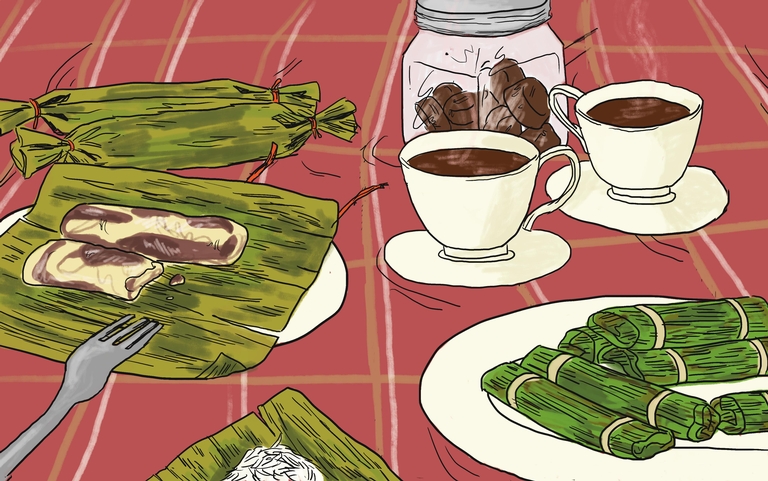

Manila (CNN Philippines Life) — In no other season throughout the year is kakanin more pronounced than during the Christmas season, and no other food quite binds the regions of the Philippines together than the sticky glutinous rice of a bright green suman.
Initially, to speak of Christmas in the Philippines (and not only in Manila) brings to mind the bounty of food not only on the table, but also on the streets. In a predominantly Catholic country, dawn masses or simbang gabi are not only tradition, but they also inevitably form the very fiber of how we celebrate Christmas: 3 a.m. awakenings, warm lights diffused in the early morning, a congregation of barely-awake mass goers, and the requisite stopover for a bite of bibingka, puto bumbong, or a plastic bag of different kinds of suman, carefully wrapped in banana leaf, to be peeled away several minutes later at the breakfast table.
The preference for kakanin at this time of the year — whether one celebrates the holidays in Manila, Cebu, or Davao — seems to cut through the islands. “The best time to experience a wide selection of kakanin is during the Christmas season,” writes Amy Besa in “Memories of Philippine Kitchens.” The “Island Christmas menu,” says culinary historian Felice Prudente Sta. Maria in “The Governor-General’s Kitchen,” “absorbed pagan rice cakes given as thanksgiving offerings to field spirits: different types of suman remain as breakfast fare for those who go to dawn masses.”
Consistently and not surprisingly, when Doreen Fernandez wrote about puto bumbong and bibingka savored during simbang gabi in “Sarap: Essays on Philippine Food,” she opined that the kakanin seems to be the common thread running along the Christmas traditions of our culturally diverse, if sometimes divergent, regions. “The simbang gabi fare in the Tagalog provinces is echoed by other rice cakes and dishes in other regions at Christmastime,” she states. “It is as if our forebears, dependent on rice as a staple and year-round pampabigat sa tiyan, gratefully gave it primacy of place in the celebration of native Christmas.”
In Ilocos, they have sinuman, a coconut rice dessert, or a “sausage-shaped soft pudding of diket rice, sugar, coconut milk, wrapped in banana leaves,” as carefully defined by Sta. Maria. The sinuman may either be sinuman ipus (cone-shaped) or latek (flattened, cone-shaped, and served with grated coconut and sugar). Compare this with Pangasinan’s tupig, a suman-like dish made out of ground glutinous rice and coconut strips, wrapped in banana leaves then cooked over charcoal, hot ash, or by burying in burning rice chaff.
“The simbang gabi fare in the Tagalog provinces is echoed by other rice cakes and dishes in other regions at Christmastime. It is as if our forebears, dependent on rice as a staple and year-round pampabigat sa tiyan, gratefully gave it primacy of place in the celebration of native Christmas.”
In Pampanga, as Fernandez writes, curious specialties include the putong sulot and the putong lusong, eaten with panara, a savory pasty stuffed with grated upo or green papaya, which is sauteed in garlic, onion, pork and shrimp, then flavored with salt and pepper for an extra kick.
In Cebu, a friend remembers budbud (steamed millet in banana leaf packets) and biko (a Chinese sweet cake made of whole sticky rice, coconut milk and sugar, cooked over low fire until cohered and dry) being Christmas staples. In Tacloban, there’s suman moron (a smoother variety of suman that is cooked in coconut milk, which can be plain or mixed with cocoa), a personal favorite. The moron is smoother to the bite than typical grainy suman, and tastes like some kind of earthy chocolate. It goes best with a cup of hot salabat, prepared the most straightforward way, according to Besa, by boiling pieces of ginger until “you get a beverage that has some bite to it.”
Not to be overlooked is tamales, a cake (traditionally associated with Mexico) made with ground rice and peanuts with meat, egg, and other flavoring, wrapped in banana leaves or corn husks. The tamales comes in sweet or noodle-based varieties; in Zamboanga, the tamales is wrapped in banana leaves, stuffed with glutinous rice, shrimp or any other meat, clear glass noodles, and may taste spicy. Other kakanin familiar in the northern regions are also eaten in Mindanao; in Cotabato, the rural communities feast on biko.

However, while traditional Christmas cuisine in the Philippines is predominantly rice-based, the impact of foreign influences is just as evident, and translates across the regions as well. Hot chocolate, for example, is an import (from Spain or Mexico, says Besa), locally adapted, among others, through the tablea de Batangas or Pampanga’s hot chocolate, made from native cacao and ground peanut. Ensaimada and empanada also became national staples as Filipinos explored baking pastries with wheat flour. Not to be forgotten is the mouthwatering Christmas ham, which has grown to be an important centerpiece of the holiday table. A friend swears by Excelente Cooked Ham, which comes in bright red packaging.
Christmas sweets include, from Pampanga, the pastillas de leche (milk candies); from Bicol, the mazapan de pili (ground pili nuts, sugar, butter and egg yolks and baked like macaroons); and from Cebu, the masareal (hard, rectangular candy made of ground peanuts and sugar). In addition, Sta. Maria says that “no Yuletide table was ever complete without a show of summertime fruits preserved in light to thick syrups,” citing santol as an example. Besa says Christmas, aside from being harvest season, is also the season of the dalandan or dalanghita, our native orange.
In a country that has known three conquerors and has been exploited for its strategic location in the Pacific, it seems that the above-described merging of Christmas traditions, both native and acquired, is inevitable. Yet despite an influx of influence and regionalism that is at times fierce and divisive, it might be reassuring to know that food — in this case, a well-cooked tube of tupig, a cylinder of suman, a cake of tamales, a cup of tsokolate or a slice of ham during Christmas — is still a potent force that not only nurtures, but unites us.
(With additional research by Gaby Gloria)