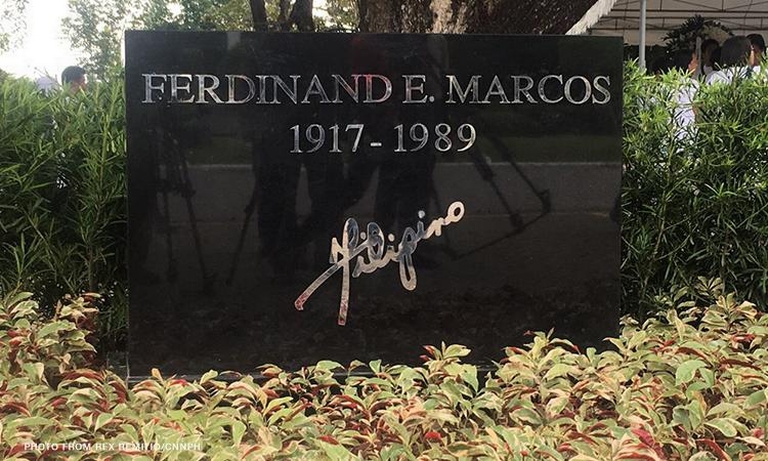

Metro Manila (CNN Philippines) — During last September’s Supreme Court hearing on the contested burial of former President Ferdinand Marcos at the Libingan ng mga Bayani (LNMB), Solicitor General Jose Calida said the burial of Marcos was part of President Rodrigo Duterte’s desire to begin the “long overdue healing” of the nation.
The Supreme Court has decided, and former President Ferdinand Marcos has been buried – but Filipinos are still divided on the issue.
For House Deputy Speaker Fredenil Castro, Marcos’ burial at the Libingan ng mga Bayani would unite Filipinos.
“I do believe that going through this issue will unite our country. Our country is already tired because from the time of Marcos and up to the present, we are still divided [as a] people,” he told “Network News” on Monday.
The lawmaker said he was an officer of the National Union of Students of the Philippines during the Marcos administration, and was “together” with martial law activist Edgar Jopson.
However, 1986 Constitutional Commission member Ed Garcia believes that Marcos’ burial represents a “step backward” for Philippine democracy.
“The constitution was crafted in the context of people’s power – the people’s resistance to dictatorship,” he explained during the same show.
Garcia said he marched during the First Quarter Storm – a series of student demonstrations against the Marcos government during the first three months of 1970. For him, reconciliation is “very important.” But he stressed that “[T]here can be no forgiveness if there’s no justice.”
“He was convicted of the malversation of billions of pesos. And the human rights violations — illegal detention, torture, extrajudicial executions and disappearances took part during martial law,” Garcia said.
However, Castro said that Philippine law “has provided enough mechanisms to address” grievances from martial law.
For the lawmaker, the Marcos acted within the scope of the law when they buried the late President last Friday. “If it was the intention of the Supreme Court that no burial shall take place during the 15-day period within which an appeal may be filed buy the petitioners, then the Supreme Court could have said so.”
On the other hand, Garcia believes that the “struggle for justice in this country requires a marathon mentality.” He pointed out that millennials – those born after Martial Law and the People Power Revolution – joined protests against the late president’s surprise burial. “Young people study, young people now have access to information — to historical truth.”
“It’s very important to recognize that if you revise history, you will be condemned to repeat it” he added.