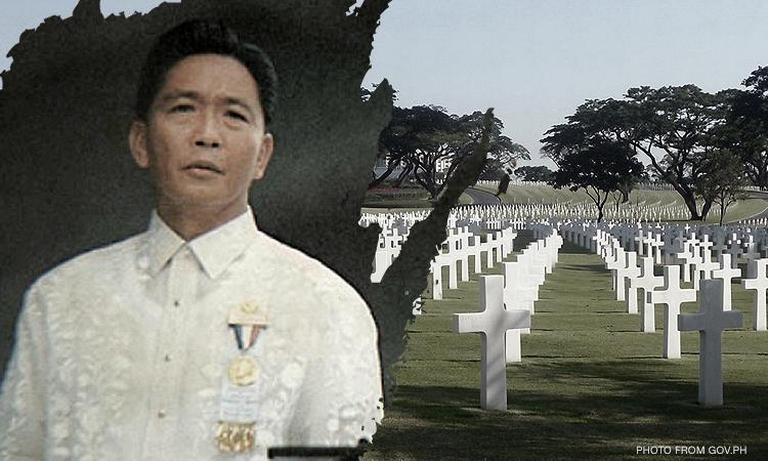

Metro Manila (CNN Philippines) — The Supreme Court ruled Tuesday that the late strongman President Ferdinand Marcos may be buried at the Libingan ng mga Bayani.
Voting 9-5, Supreme Court spokesperson Ted Te said the high court dismissed all the petitions challenging Marcos’ burial at the heroes’ cemetery based on five substantive grounds:
There was no grave abuse of discretion on the part of President Rodrigo Duterte in ordering the burial of Marcos at LNMB because it was done in the exercise of his mandate. There is also no law that prohibits the burial of Marcos’ remains at the LNMB.
President Duterte has the power to reserve for public use and for specific public purposes, any of the lands under public domain.
Marcos’ remains, under regulations of the Armed Forces of the Philippines, can be interred at LNMB because he was a former president, commander-in-chief, soldier, medal of valor awardee, and legislator.
The Supreme Court disagreed Marcos was “dishonorably discharged,” saying the disqualification only pertains to the military
Marcos cannot be disqualified from burial at LNMB because he was not convicted of crimes involving moral turpitude.
Associate Justices Arturo Brion and Lucas Bersamin both voted in favor of the Marcos burial. CNN Philippines shows you their full concurring opinions and highlights their major points.
Bersamin: Marcos ‘entitled’ to be buried at LNMB
For Justice Bersamin, Duterte did not abuse his presidential power in ordering Marcos’ burial at the Libingan ng mga Bayani because the late strongman is qualified under the law.
“President Marcos – being a former President of the Philippines, a Medal of Valor awardee, a veteran of World War II, a former Senate and Senate President, and a former Congressman – is one of those who remain entitled to be interred in the LNMB under the terms of (Armed Forces of the Philippines) AFP Regulations G 161-375,” he said.
Bersamin also reiterated that the AFP’s grounds for disqualification for burial at the heroes’ cemetery — dishonorable discharge from military service and conviction of an offense involving moral turpitude — do not apply to Marcos.
“The contention that he had been ousted from the Presidency by the 1986 People Power revolution was not the same as being dishonorably discharged because the discharge must be from military service,” he said.
The main decision noted that although Marcos was ordered by a Swiss and a Hawaiian court to compensate Martial Law victims, these were civil cases, which are not covered under convictions of moral turpitude.
Brion: Supreme Court not the right body
Meanwhile, Justice Brion highlighted a more fundamental issue in his opinion: Does the Supreme Court have the power to review and act upon Duterte’s order?
“I find that these petitions failed to establish the necessity of the Court’s direct exercise of its power of judicial review, as their cited legal bases and arguments largely involve violations of the law or its misapplication,” he said.
Brion explained that the Supreme Court may only decide on whether an act of government is legal based on the Constitution, not based on ordinary laws. He said the petitioners failed to point out which provision of the Constitution Marcos’ burial would violate.
“The Court’s direct authority to exercise its expanded jurisdiction is limited to the determination of the constitutionality of a governmental act,” he said. “Grave abuse of discretion arising from mere violations of statutes cannot, as a rule, be the subject of the Court’s direct exercise of its expanded jurisdiction.”
Brion also said the petitioners should have gone through administrative bodies or the lower courts before filing for a temporary restraining order with the Supreme Court.
The main decision said the petitioners could have appealed to the President, the Secretary of National Defense or a Regional Trial Court first.
“For these statutory violations, recourse may be made before the courts through an appeal of the administrative body’s ruling, or by filing for a petition for declaratory relief before the lower court with jurisdiction over the matter,” he said.
Brion: Burial does not erase Martial Law abuses
In addition, Brion said burying Marcos at the Libingan ng mga Bayani does not excuse the abuses during the Martial Law era.
“The burial order does not have the effect of rewriting jurisprudence and excusing the ills of the Marcos administration,” he said. “Neither does it amend Republic Act No. 10368 (“Human Rights Victims Reparation and Recognition Act of 2013.”
R.A. 10368 established a Human Rights Victims Claims Board tasked to recognize victims of human-rights violations and provide them with compensation funded by the ₱10 billion in Marcos ill-gotten wealth awarded by a Swiss court in 1997.
Finally, Brion explained that although he is “not insensitive” to the plight of victims of Martial Law, the Supreme Court is tasked with upholding the law, even though its decision may be unpopular.
“The Court, of course, is not blind to history but is not a judge of history,” he said. “Ultimately, we recognize that vowing to the raucous crowd may temporarily signify harmony, but we do so at the expense of disregarding Executive policy and weakening the political branches, and indeed, the very institution of government itself.”