
Metro Manila (CNN Philippines) — Starting Friday, all cigarette packs, imported or local, must carry graphic health warnings.
Republic Act 10643 (also known as The Graphic Health Warnings Law) was enacted in July 2014, but its full implementation began Nov. 4.
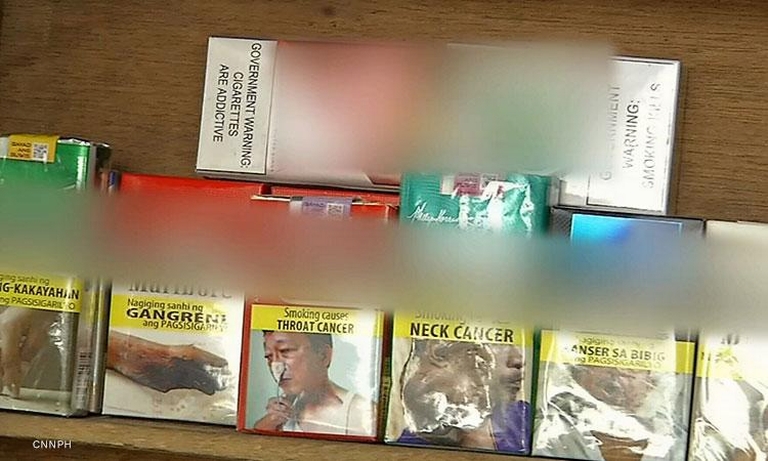
These graphic warnings are photos and text printed in the lower portion of each pack that show the dangerous, even fatal, effects of smoking, such as mouth cancer and stroke.
The law also prohibits manufacturers from printing descriptions like “low tar,” “light,” “ultra lights” or “mild,” which convey that the product is healthier or safer.
“We’d like to ensure that our countrymen are aware of the ill-effects of tobacco and, therefore, if they are using it, they will stop,” said Department of Health (DOH) Secretary Paulyn Ubial.
The 2015 Philippine Global Adult Tobacco survey showed that there are 16.5 million Filipino adult smokers nationwide. In addition, the DOH said 10 Filipinos die of smoking-related diseases every hour.
The law, however, does not prohibit selling per stick, which prevents smokers from seeing the graphic health warnings on cigarette packs. Sec. Ubial said her agency is advocating local government units (LGU) to prohibit sales by the stick.
In addition, some vendors even admit displaying packs without graphic warnings.
“Yung iba po, walang naka-sign na mga picture,” said vendor Teresita Marquez. “Ganun pa rin po yung ibinibigay sa amin.”
[Translation: Some of the packs don’t have the pictures. The unmarked packs are still what are being given to us.]
But some are already complying with the law.
“Pinullout namin kagabi para isoli sa mga manufacturers,” said store owner Steven Cua.”Of course, iniwan namin ito until yesterday hoping na mabenta pa.”
[Translation: We pulled out the unmarked packs last night to return these to the manufacturers. Of course, we left these on the shelves until yesterday hoping that it would still be sold.]
The DOH said LGUs will be tasked with policing the law and that those who will not comply with the new law will face penalties.
Tobacco manufacturers, importers and distributors will have to pay a fine of ₱500,000 to ₱2 million. On third offense, they could not only lose their business permits and licenses, but also face up to five years in jail.
Meanwhile, sellers, including sari-sari stores, will have to pay a fine of ₱10,000 to ₱100,000, with up to a year in prison and the revocation of business permits and licenses on the third offense.
Health authorities are also looking forward to a smoke-free environment once President Rodrigo Duterte signs the executive order banning smoking in all public areas.
Read: No-smoking policy EO awaiting Duterte’s signature