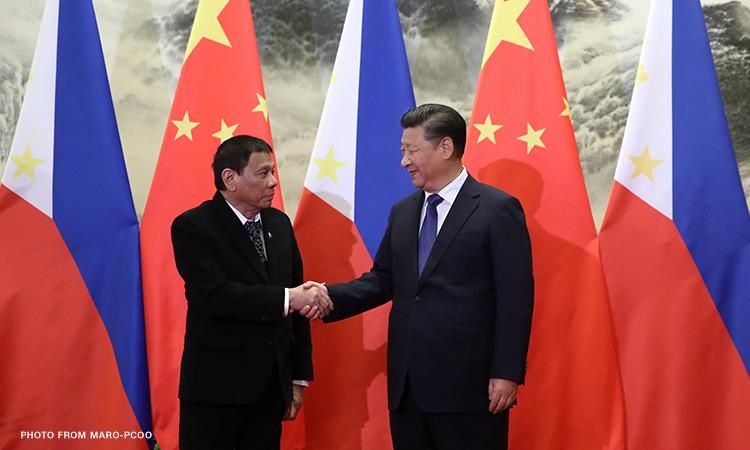

Metro Manila (CNN Philippines) — President Rodrigo Duterte’s announcement of a military and economic “separation” by the Philippines from the United States has drawn mixed reactions from lawmakers.
On Thursday, Duterte said during a trade forum in Beijing that “America has lost” and that he has realigned himself with China’s “ideological flow.”
“Maybe I will also go to Russia to talk to Putin and tell him that there are three of us against the world – China, Philippines and Russia,” he said.
Read: In China, Duterte announces split with U.S.
For Albay Rep. Edcel Lagman, the statement was Duterte’s “usual hyperbole.” The lawmaker said Duterte “did not mean it,” and that he was just “catering to the goodwill of his Chinese hosts.”
According to Lagman, the Philippines cannot afford to completely sever ties “with traditional economic and security allies like the U.S.”
Magdalo party-list Rep. Gary Alejano expressed concern about Duterte’s statement, but was not surprised by it.
“Pres. Duterte often utters conflicting statements with regards his foreign policy, but his recent announcement to align ourselves with China did not come as a surprise. Early on, Pres. Duterte is inclined to veer away from the U.S., our long-time ally,” he said.
Alejano looked at relations between the Philippines and China through the lens of their overlapping claims in the West Philippine Sea (WPS).
“The more the Philippine economy is exposed to China, the more our economy becomes dependent on them, the lesser our power to assert will be, pertaining to our territorial conflict in the West Philippine Sea. The Philippines will be on the losing end when it comes to the WPS issue,” the congressman said.
For Ifugao Rep. Teddy Baguilat, the U.S. “means much more” to the Philippines economically than China. He explained that “many” Filipinos derive their livelihood and income from the U.S. Through remittances and employment from U.S.-based BPOs, manufacturing, and the services sector.
“Parang [It’s like] the president is letting his personal dislike of American libertarians cloud his diplomatic overtures and foreign policy directions,” Baguilat said.
He pointed out that relations with individual countries do not have to be mutually exclusive, noting that the country’s Southeast Asian neighbors “seem” to have no trouble working with both China and the U.S.
“Kailangan ba itakwil ang isa para ligawan ang iba? [Do we have to betray one to court the other?] We can say we love China, and we still love the U.S. Why can’t we get all those Chinese yuan without discarding American dollars? That’s the ideal,” he noted.
Sen. Antonio Trillianes was far more critical of Duterte: “If he thinks like a communist, talks like a communist, frees the communists, and appoints the communists, then he must be a communist.”
Sen. JV Ejercito expressed concern over a possible “economic backlash.” He pointed out that the U.S. is still the biggest trading partner of the Philippines, and that U.S. BPOs employ about a million FIlipinos.
“This matter should have been studied throughly. We could pursue an independent foreign policy without necessarily cutting ties with the U.S.,” he remarked.
For Sen. Win Gatchalian, Duterte’s statement needs to be clarified by cabinet members on the scope and reach of the supposed “separation.” He said the administration’s independent foreign policy is a “catalyst” for renewed nationalism, but he would rather engage all countries in trade and commerce to enhance the economy.
Sen. Ralph Recto said the country should practice “big-tent diplomacy” – welcoming all, and shunning no one.
“Yes, our relations with the United States may not be perfect, but a country which has illegally built a great wall of sand in our seas is not, and far from, the epitome of a good friend either,” he pointed out.
Sen. Leila De Lima accused the President of keeping the his foreign policy views to himself, and surprising everyone.
“It’s one thing to keep your Cabinet members in the dark – which is deeply troubling in itself – but it’s a whole level of betrayal to keep that from the Filipino people, and to announce it for the first time in front of foreigners,” she pointed out.
Trade Secretary Ramon Lopez told CNN Philippines’ The Source that the country is not stopping trade and investments with the U.S.
He said, “The President basically mentioned his desire to strengthen further and rekindle ties with China and the ASEAN region which we have been trading with for centuries.”
The Senate plays an important role in Philippine foreign policy as the Constitution requires at least two-thirds of Senators to ratify any treaty or international agreement before it can be implemented.