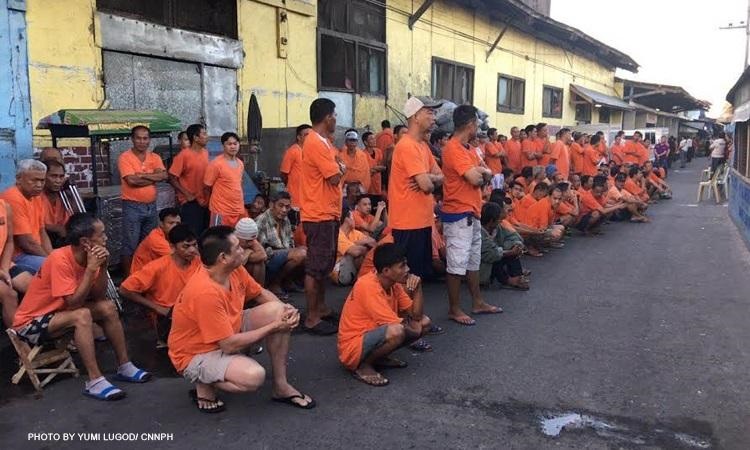

Metro Manila (CNN Philippines) — From the Manila City Jail to the New Bilibid Prison (NBP), prison gangs have recently been making headlines.
Thursday’s incident involving 200 members of the Batang City Jail at the Manila City Jail resulted in the injury of up to 40 inmates and jail personnel. The gang members reportedly staged a noise barrage over a new segregation policy.
At the NBP, gang leaders and other high-profile gang members exposed how they controlled a multi-billion peso drug trade from the inside.
Experts says the existence of prison gangs is a characteristic unique to the Philippine penal system, as a way of coping with the lack of resources and personnel.
At the Bilibid-Maximum Security Compound, up to 95% of inmates belong to any of 12 gangs there.
This was shown by a study conducted by University of the Philippines professor, Dr. Filomin Candaliza-Gutierrez. This gives an insight into why gang leaders and their high-profile inmates wield such influence and power not only on prisoners, but even Bureau of Corrections (BuCor) officials and personnel.
Role of prison gangs
Gutierrez points to the 1950’s when gangs or “pangkat,” as they’re called by inmates — the Filipino term for group, gained notoriety inside prisons as they functioned as combat groups meant to defend one’s self from other inmates.
According to Gutierrez, gang rivalry was defined by ethno-linguistic identity.
Tagalog-speaking inmates formed the Sigue Sigue (from the Spanish seguir, meaning, “to pursue”) while the Visayan- speaking, from Cebu, Samar, Leyte, Masbate and Iloilo as well as Mindanao formed the OXO (Original Ex-convict Organization).
Gang riots became common in the Bilibid then.
In 1958, when nine OXO members were brutally killed by the Sigue Sigue gang, even the Supreme Court acknowledged the role of gangs for survival.
The court downgraded to life imprisonment the death sentence on the 14 members of Sigue Sigue, noting inhuman conditions in prison may have contributed to the violence. In a July 30, 1965 ruling, the court said:
“It is evident that the incredible overcrowding of the prison cells, that taxed facilities beyond measure and the starvation allowance of 10 centavos per meal for each prisoner, must have rubbed raw the nerves and dispositions of the unfortunate inmates, and predisposed them to all sorts of violence…. All this led inevitably to the formation of gangs that preyed like wolf packs on the weak…”
Gutierrez notes, riots lessened over the years with more relaxed visitation policies and the entry of foundations and other civil society groups who helped inmates through different programs.
With this, the pangkat assumed different functions not only for an inmates’ security and protection but also for friendship and brotherhood and as small governments within a government.
Henry Balingasa, a former inmate at the Medium Security Compound, credits the Sigue Sigue Commando gang for helping him survive his sentence of more than eight years, for theft and robbery. He even got twin tattoos on his chest, proudly showing he’s a gang member.
For Balingasa, belonging to a gang took his mind off his imprisonment and kept him busy with the his duties assigned by the gang. He was a “runner,” tasked to escort visitors to inmates’ cells. “Kasi kapag wala kang gang sa jail, kawawa ka tagahugas ka ng pingggan, utusan ka, alilang-alila ka,” says Balingasa.
Perhaps the gang’s most important role is co- administration, says Gutierrez, “The pangkats were basically functioning to provide needs of members to artbitrate disputes, to provide anuman kakulangan na wala sa Bureau of Corrections. Some of them are also responsible for creating livelihood projects, programs for rehabilitation.”
Southern Illinois University-Carbondale Prof. Raymund Narag, who himself was an inmate at the Quezon City Jail said prison officials have informatlly recognized gangs as a coping mechanism to deal with the lack of BuCor personnel.
The ideal prison personnel-to-inmate ratio, as provided for in the 2013 BuCor Modernizatoin law is 1:7, in Philippine prisons. But BuCor Public Information Chief, Insp. Eusebio del Rosario Jr., explains, the actual ratio can be much higher. On the average, the ratio in the country’s prisons is 1:68.
Furthermore, he says — considering personnel assigned to adminstrative functions, and three duty shifts per day — this would put to 1:457 the prison personnel to inmate ratio at the maximum security compound.
Gang commanders, or the bosyos, are allowed to police their own ranks and so help keep order in prison. They even assign innmate-marshalls. In return, gang leaders are given perks or special considerations.
Narag notes how this set-up mirrors the nature of the political leadership outside, where officials are known to engage in corruption and use guns, goons and gold to remain in power. And as revealed in marathon hearings in the House of Representatives, gang leaders and other high-profile inmates admitted how they corrupted the BuCor: to perpetuate the drug trade and other illegal activities inside the Bilibid.
Justice Undersectretary Enan Orceo laments how the government, in the last administration, seemed to have given up authority over the inmates, “Pag humingi ka ng tulong sa kanila natural magkakaron ng privilege, bargaining chip. Ang aking assessment dyan, nawalan ng control. Since nawalan ka control, you lose everything.”
Ending the prisons’ dependence on gangs
The current BuCor leadership, under the Department of Justice, is taking steps to dismantle the stronghold of gangs and stop their illegal activities.
First, the demolition of their lavish ‘kubol’ or cubicles where gang leaders and other high-profle inmates have taken up residence, instead of a regular jail cell. They have now been isolated from the rest of the prisoners in the highly-secured Building 14.
More than 300 members of the PNP Special Action Force are taking over security for an indefinite period.
Signal jammers and surveillance cameras were installed in almost all corners of the facility, to prevent the gang leaders from coordinating their illegal activities.
Del Rosario said in the past, they used milk to remove tattoos of gang members. While this may be cosmetic and superficial, he notes, it helps inmates realize they can do without their gangs, “This was practice before in the education section, for High School and College, that we erase the gang marks of every enrollee. So nanyayari nawawalan sila ng pangkat, ng gang. Naka-focus ang atttention nila ngayon to the program. So pwede natin talaga alisin, we can do that.”
Del Rosario stresses Republic Act 10575, or the 2013 BuCor Modernization Law, will also serve as a permanent solution; helping rid the country’s penal systems of the need for gangs. It provides for the hiring of additional personnel and expansion of prisons and other facilities.
Another feature of the the law would be the required segregation scheme. At present, the maximum security compound houses inmates based on their gangs, or what’s called the congregation practice. Under RA 10575, the BuCor would have to strictly adhere to segregation by security classification, and crimes committed.
The law stresses, “This is to ensure that an inmate will not be susceptible to acquire other criminal skills — brought about by his exposure with other inmates, who are committed to BuCor for different crimes or offenses, which normally happens in the present prison setup.”