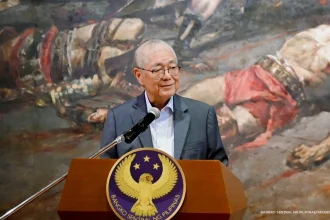

Davao City (CNN Philippines) — More than 500 entrepreneurs from Mindanao met with the top business leaders in the country for a mentoring program.
Non-profit organization GoNegosyo, along with the Department of Trade and Industry (DTI), brought together micro, small and medium enterprises (MSME) to learn best business practices.
“Success is no accident. It is hard work, perseverance, learning, studying, sacrifice and above all, love for what you are doing, or love of learning to do,” Ma. Belinda Ambi, DTI regional director said in the forum on Friday.
She congratulated the entrepreneurs for taking advantage of the opportunity to learn more about their business. It was a standing-room-only event, with organizers admitting that they didn’t expect such a high turnout.
Majority of the attendees were in agriculture-related businesses, such as coffee and cacao.
Joseph Calata of listed agribusiness Calata Corp. encouraged them to join the sector.
“The average age of the Filipino farmer is 57 years old,” he said. “We need more people to come in. Unfortunately, the younger generation today think farming is poor and dirty work.”
The Philippines also has an advantage when it comes to agriculture because of its abundant natural resources.
Rosalind Wee of the W Group said the country is one of the top exporters of seaweed and seaweed products because they can easily be grown in islands like the Sulu archipelago. A seaweed farm can produce as much as three tons of seaweed in a month, she said.
Bohol Rep. Arthur Yap identified reforms that could help support budding agribusinesses. Chief among them is improving access to financing.
Formal lenders still require entrepreneurs to show property for collateral, Yap said.
However, only 22% of MSMEs hold land, so majority tend to be turned down when they apply for loans.
“We may not have land, but we have receivables. We have assets — a motorcycle, a TV, a refrigerator,” Yap said.
Yap, a former Agriculture secretary, urged the Duterte administration to pass a bill that would set a legal framework so these so-called “movable assets” could be used as collateral.
He also backed mandatory crop insurance for farmers. He said new models of insurance were being developed so payouts could be released as soon as output drops; affected farmers would no longer have to wait until the end of the harvest season to get their money.
For entrepreneurs like Jane Juico, mentoring programs were crucial in developing her business sense. A farm owner in Mati, Davao Oriental, she learned about intercropping when her sister attended a DTI seminar.
“Sabi nila, cacao ay isang crop na magandang isalit-salit sa copra, kaya nagsimula kami mag-intercrop. Gumawa na din kami ng sarili naming cacao seedling nursery para hindi na namin kailangan bumili ng seedlings sa iba,” Juico said in an interview.
[Translation: They said cacao is one crop that can be planted when copra is out of season. So, we started intercropping. We also started our own cacao seedling nursery so we don’t have to buy seedlings from others anymore.]
Hearing from business leaders also encouraged her to push on even after a tough year for her farm.
“Madami kaming punong nasira dahil sa El Niño. Pero tuloy pa din. Mamo-motivate ka sa mga sinasabi nila na you have to try kahit may downfall… Sabi nga ng ate ko, that’s part of business, the risk,” Juico said.
[Translation: A lot of our trees died during El Niño, but we will keep on going. I got motivated when I heard them say that they just kept on trying despite downfalls… My sister told me, that’s part of business, the risk.]
Inday Banquerigo also started her business after attending a DTI seminar. The Labor Department helped her source raw materials.
“We are now into the business of sewing kit bags, sewing t-shirts, uniforms. We supply convention kits and all other seminar requirements and giveaways,” she said in an interview. “Because it opened our eyes to wider opportunities. There is really a wide market outside, and all we have to do is just to link up so that we can get that opportunity and expand our business.”
Now, Banquerigo is paying it forward. She has expanded her sewing business into a livelihood center, hiring people who have a hard time finding work: out-of-school youth, single mothers and returning overseas workers.
Starting a business is no easy feat, she said. But for budding entrepreneurs, they know by personal experience that a hand up goes a long way.