
Metro Manila (CNN Philippines) — At only 17 years old, Jenny Anfabe has been playing mother to her 10 siblings. Five years ago, Jenny’s mother died because of complications during childbirth.
She said her mother could not get regular check-ups during her pregnancy.
“Sa murang edad niya at 41, unexpected talaga na hanggang doon na lang talaga ang buhay niya,” said Jenny.
[Translation: “At a considerably young age of 41 years old, my mother’s death was really unexpected.”]
“Kasi sabi ng doktor niya, bawal na daw siya magbuntis dahil [may] high blood [pressure] siya and bawal din po siya gumamit ng contraceptives.”
[Translation: “My mother’s doctor warned her that she must avoid getting pregnant since she has been diagnosed with high blood pressure. The doctor also discouraged her to use contraceptives.”]
In 2011, there were 221 deaths for every 100,000 live births, based on the latest Family Health survey.
According to the Population Commission (POPCOM), this year’s figures may exceed that — from 120 maternal deaths for every 100,000 live births, it may double because many couples lack access to contraceptives.
POPCOM said figures may reach to at least an additional 110 maternal deaths and about 50,000 cases of unwanted pregnancies.
According to studies, lack of access to medical care and contraception is highest among women aged 15 to 19, especially those with five or more children.
Usually, these women live in rural areas, with no proper education. They most often belong to the poorest of the poor.
“Poor women are less likely to go for pre-natal care,” said POPCOM executive director Dr. Juan Perez III.
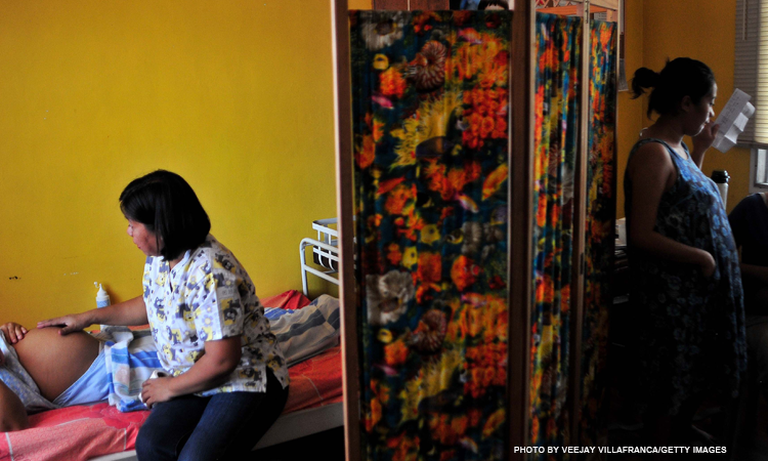
Many of these mothers are dying of complications during pregnancy or at childbirth because they have no access to proper medical care.
Perez mentioned another way to reduce the number of maternal deaths: prevent unwanted pregnancies.
However, Congress has cut a big portion of the budget for family planning services, including free contraceptives for the poor.
Unwanted pregnancies result to abortion
As a result, mothers who belong to the poorest households have no means left to prevent unwanted pregnancies.
With prevention no longer possible, many of these mothers are forced to get abortions.
Perez said, at a rate, 41% of women resort to abortion because of unintended pregnancies.
The health department said pregnant women should have prenatal care regularly from the first to the last trimester, including a postnatal checkup.
“A lot of women still don’t go to facilities… They will only go if they are respected there,” said Dr. Junice Melgar, executive director of the Likhaan Center for Women’s Health.
Every birth should be done by skilled birth attendants in health facilities, and birthing homes in far-flung areas should be upgraded for those with special maternal health needs.
The Department of Health (DOH) said 34% of maternal deaths are caused by hypertension, 16% due to bleeding, while abortion accounted for 9% of deaths.
The country’s goal is to reduce maternal deaths to 52 for every 100,000 live births.