
Editor’s note: The opinions expressed here are solely the author’s.
Metro Manila (CNN Philippines) — Last time I checked, there were about 800,000 words in the English language. Now, there are more than a million.
Aside from spelling, plural forms, tenses, pronunciation and moods, the language also hosts other inconsistencies that defy logic. There are as many rules as there are exceptions.
Compared to Filipino, hands down, our native tongue is a lot simpler.
Take for example, verb conjugation. Pinoys simply add two letters at the beginning or in the middle part of the rootword called unlapi, gitlapi and hulapi. It’s this simple:
kain kumain kinain
tulog natulog natulog
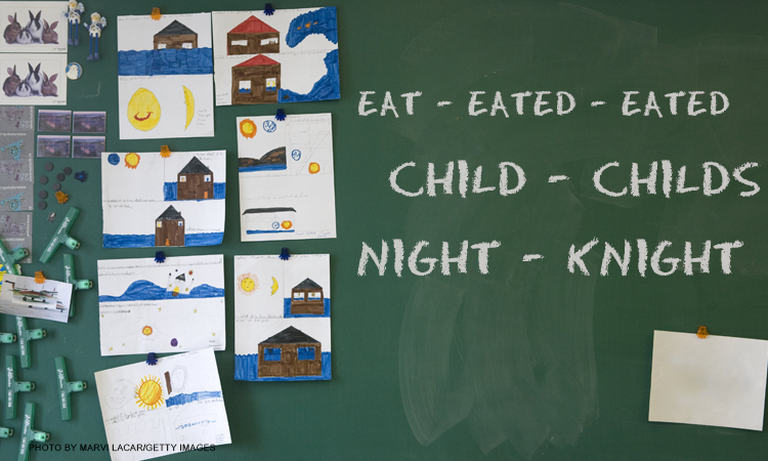
If we follow the same logic in English, this should be the conjugation:
eat eated eated
sleep sleeped sleeped
Of course, if you do that, you’ll flunk your subject.
You are an idiom!
Verb conjugation is just the tip of the iceberg.
Let’s go over the more interesting ones — and a personal favorite: idioms.
Idioms make a sentence more emphatic and colorful, but certainly would leave one scratching his head.
Take this idiom: keep an eye out for. It means watch out or be alert for something. But why just an eye? Don’t we need to use two eyes for a better view?
Here are a few more:
on foot — Don’t we need two feet when we’re walking? Used in a sentence, “The soldiers went on foot.” That’s very difficult to do.
all ears — We just have a pair of ears, why not just say, “I’m both ears.”?
mark my word — And then what follows is a sentence.
The same goes for “give someone a hand,” and the list can go on and on. (Of course, we’re talking about American English here. But there’s also British, Canadian and Australian English.)
We also often hear the expression “needless to say” or “not to mention.” But how come the speaker goes on to say or mention it anyway?
But perhaps the most saliently inconsistent pair of words can be found by just strolling around.
A local comedian pointed this out when he passed by a fire station.
The sign says, example, Manila or Quezon City Fire Station.
If the sign says, Manila Police Station, one would find a lot of policemen in there. But where’s the fire in fire stations? Wouldn’t it make more sense if it were renamed as Manila Firemen Station.
You could come up with your own list — proving that it is really not a no-brainer to master our “second tongue.”