
Metro Manila (CNN Philippines) — It is still a week before the campaign period, but pre-campaign posters and tarpaulins of aspiring candidates are all-over Metro Manila.
This could just be a preview of how much garbage would be generated after the May 9 polls.
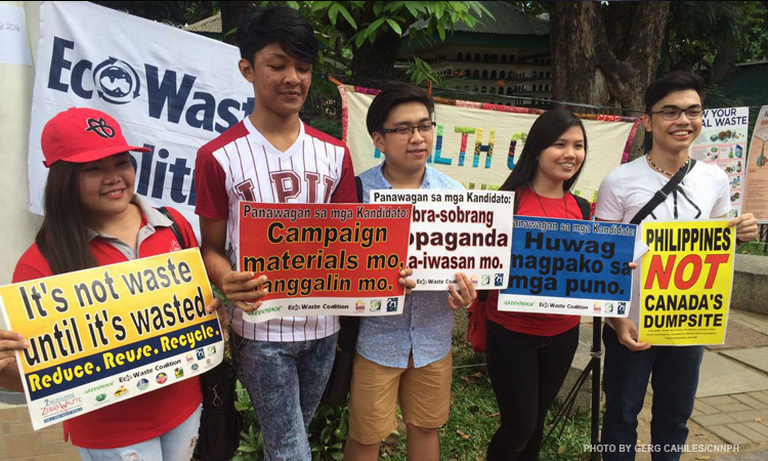
During the Zero-Waste Fair in Rizal Park on Sunday (January 31), hundreds of students from various schools joined a campaign seeking trash-free 2016 elections.
“Minsan po hindi nila tinatanggal, nilalagay lang po nila — hindi nila tinatanggal. Hinahayaan lang nila mabulok na lang doon, di nila nililinis… May negative chance na iboboto ko po sila kung ganon ang ginagawa nila,” said Carl Timonera.
[Translation: “Sometimes, they don’t remove them (campaign materials). They just put up the materials and leave them to rot. They don’t clean them. There’s a negative chance that I will vote for them if that’s what they do.”]
“Mas maganda po kasi kung iboboto natin yung mas ano nila ang environment,” remarked Lady De Luna.
[Translation: “It’s better that we vote for people who are more concerned with the environment.”]
Adding up to country’s garbage and toxic problems
Commission on Elections (Comelec) data show that 45,990 individuals filed their Certificates of Candidacy last year for 14 national posts, 59 party list representatives and 18,010 local posts.

Environmental advocates said that with the number of candidates on the campaign trail, one can just imagine the volume of campaign materials that will be generated — and most of these may end up as garbage.
For instance, environmental watchdog EcoWaste Coalition pointed out the unrestrained use and disposal of tarpaulins are adding to the country’s garbage and toxic problems.
“Yung ating mga botante rito na kabataan, gusto natin sila maging aware na ang mga pulitiko dapat mapagmahal din sa kalikasan. Kasi environment is equivalent to public health safety. Sila ang makikinabang doon,” said EcoWaste Coalition Coordinator Aileen Lucero.
[Translation: “We want our young voters to be aware that politicans should care for the environment, because it is equivalent to public health safety. They will benefit from that”]
The group explained that there are alternative materials that can be used as campaign posters like tafetta and non-woven plastic cloths.
They said these these materials contain less toxins.
Tarpaulins may also be recycled, and may be converted into shopping and storage bags.
“Manalo matalo, kunin ang mga campaign paraphernalia na sinabit, ibigay na lamang, kesa itonay itapon o sunugin, ibigay sa community na gumagawa ng mga livelihood materials. Gaya ng ginawa natin, ginawa natin siyang shopping bags,” Lucero added.
[Translation: “Win or lose, candidates should retrieve campaign paraphernalia and give them away for recycling, rather than throw them away or burn them. They can give the materials to communities who make livelihood materials. In our case, we make them into shopping bags.”]
“Kalat ko, Linis ko”
The Comelec and the Departments of Environment and Interior and Local Government (DENR and DILG) have also renewed their commitment in making sure that national and local candidates will properly dispose their garbage from campaign materials and help in cleaning up the surroundings after the election.
The campaign called “Kalat Ko, Linis Ko,” was launched in anticipation of the large volumes of waste produced during the election period due to the proliferation of posters, flyers and other campaign paraphernalia.
DENR, DILG and Comelec officials earlier signed a manifesto of commitment to implement a memorandum circular that will ensure political parties, candidates and their supporters will comply with the provisions of the Ecological Solid Waste Management Act during and after the elections.