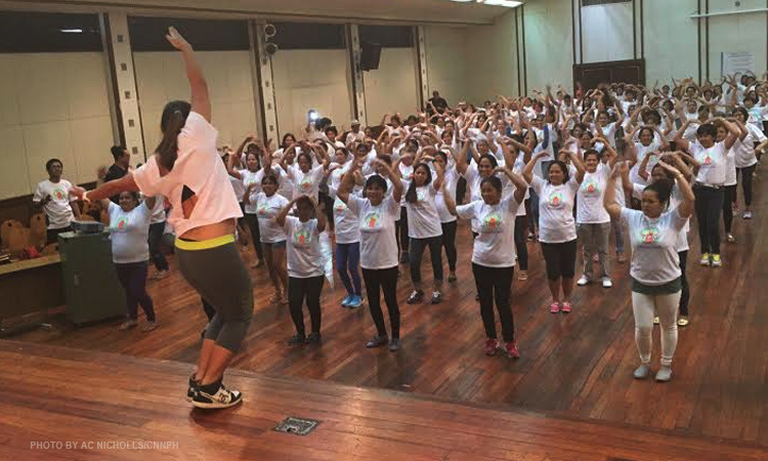

Metro Manila (CNN Philippines) — More than two hundred domestic workers gathered in the Occupational Safety and Health Center, Diliman, Quezon City on Sunday (January 24) to mark the third anniversary of the enactment of the Kasambahay Law (Domestic Workers’ Law).
Amid celebrations, a group of domestic workers complained that provisions of the law are not implemented.
Novelita Palisoc, leader of the United Domestic Workers in the Philippines, said many employers refuse to enroll their house help to insurance programs.
The Kasambahay Law entitles domestic helpers to standard employee benefits, including paid leave, a set minimum wage, and coverage in insurance programs.
“Nagsasagawa kami ng survey at lumalabas na kakaunti lang po yung meron pong SSS [Social Security System], Pag-IBIG, PhilHealth. Yung iba din po nagreregister lang sila as self-emplyed,” said Palisoc.
[Translation: “Based on our survey, only a few domestic workers have SSS, Pag-IBIG, PhilHealth. Others just register themselves as self-emplyed.”]
The government said the problem is a lack of information, as many employers remain unaware of their obligations.
There are about two million Filipinos working as domestic helpers in the country. Out of that two million, government data shows only about a hundred and twenty thousand are registered with the SSS, and even less with PhilHealth and Pag-IBIG.
Labor officials said domestic workers can report employers to the barangay office, should abuses happen.
“Unless it is really necessary — I cannot imagine that the penalties will be the first remedy because tandaan pag may penalties man, babalik din ang kasambahay sa bahay ng employer. So its very difficult to maintain a good relationship when we talk about penalties,” said Department of Labor and Employment Undersecretary Ciriaco Lagunzad III.
Aside from insurance coverage, some domestic workers said getting weekly rest days can also be difficult.
Palisoc encouraged fellow house helpers to assert their rights.
“Kumbaga kulang din sila sa lakas ng loob kasi po kung hindi rin nila igi-giit na dapat sa loob ng isang buwan….sa isang buwan, may apat na araw silang off every week”]
If it is proving to be difficult here, the government said protecting the rights of Filipinos working as domestic helpers abroad is a bigger challenge.
Even though they are at risk of abuse and other dangers, many Filipinos still work as domestic helpers abroad.
In 2014, about thirty eight percent of the total number of Overseas Filipino Workers are recorded as domestic workers, according to figures from the Philippine Overseas Employment Agency.