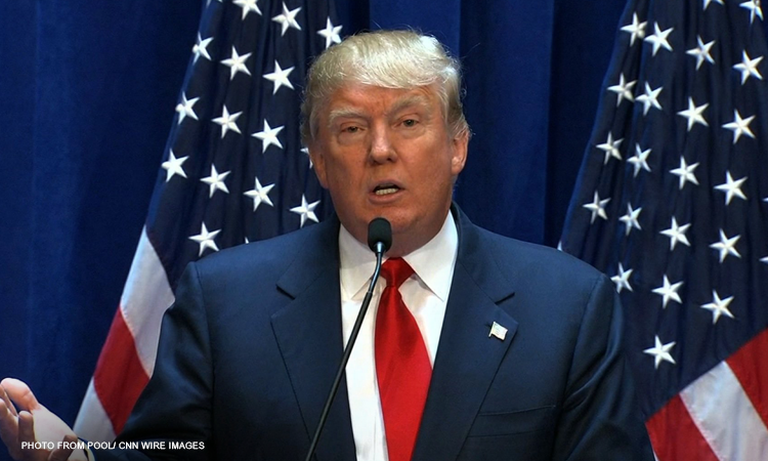

(CNN) — Donald Trump holds double-digit leads over Ben Carson in both South Carolina and Nevada, the third and fourth states scheduled to hold nominating contests in next year’s race for the presidency, with Trump widely seen in each state as the best candidate to handle a range of top issues, according to new CNN/ORC polls.
Trump holds 38 percent support in Nevada, with Carson in second with 22 percent, and in South Carolina, Trump doubles Carson’s support, 36 percent to 18 percent. No other candidate comes close to those top two in either state; the third-place candidate in each case has less than 10 percent support.
Trump’s backing in both states outpaces his support in most recent national polling, where he tends to draw around a quarter of Republican voters.
In Nevada, where more than half of likely caucus participants say they have made up their mind or are leaning toward someone, Carly Fiorina takes third place with 8 percent, followed by Florida Sen. Marco Rubio with 7 percent and former Florida Gov. Jeb Bush with 6 percent. Texas Sen. Ted Cruz and former Arkansas Gov. Mike Huckabee are next at 4 percent each, with the remainder of the field at 2 percent or less.
Trump’s supporters in Nevada are more committed than others: Among those likely caucus-goers who say they have made up their minds or are leaning toward someone, 53 percent support Trump, 21 percent Carson, 7 percent Rubio, and everyone else is at 5 percent or less. Those who say they are still trying to decide whom to support break 21 percent each for Carson and Trump, 12 percent for Fiorina, 10 percent for Bush, 9 percent for Huckabee, and 6 percent for Rubio.
Among all likely voters in South Carolina, Rubio takes third with 9 percent, followed by Fiorina at 7 percent, Bush at 6 percent, Cruz at 5 percent, and the state’s senior senator, Lindsey Graham, also at 5 percent. Kentucky Sen. Rand Paul follows at 4 percent, with Huckabee at 3 percent and the rest at 2 percent or less.
Fewer South Carolina Republican voters say they have made up their minds about whom to support than among Nevada Republicans: 60 percent say they are still trying to decide, and the difference in candidate support between the two groups is not large enough to be significant.
Trump’s lead rests on widespread perceptions that he’s the best candidate to handle the economy (67 percent say so in Nevada, 59 percent in South Carolina, while no other candidate hits double-digits) and illegal immigration (55 percent in Nevada and 51 percent in South Carolina, topping the other candidates by 40 points or more). About 6 in 10 in each state say Trump is the candidate most likely to change the way things work in Washington (60 percent in Nevada, 58 percent in South Carolina). Furthermore, nearly half – 47 percent in Nevada and 44 percent in South Carolina – view Trump as the candidate with the best chance of winning the general election next November.
Trump’s strength fades somewhat on foreign policy, handling ISIS and social issues. Although Trump tops all other candidates by significant margins when voters and caucus-goers are asked which candidate would best handle foreign policy (he’s up 21 points in Nevada, and 13 points in South Carolina) and ISIS (he tops Rubio by 33 points in Nevada and tops Graham by 27 points in South Carolina), his advantages are smaller than those he’s built on the economy and immigration.
Trump is also slightly less dominant on which candidate best represents the values of Republicans like themselves. In Nevada, 34 percent say that’s Trump, 19 percent Carson, 10 percent Cruz, 9 percent Rubio, and 7 percent each Bush and Fiorina. In South Carolina, 25 percent say it’s Trump, 19 percent Carson, 10 percent Bush, 8 percent Rubio, 7 percent Graham, 6 percent Cruz, and 5 percent each Fiorina and Huckabee.
On social issues, Trump runs about even with Carson as most trusted in both states, 25 percent Trump to 23 percent Carson in Nevada and 26 percent Carson to 22 percent Trump in South Carolina.
Among white evangelical protestants in South Carolina, who made up about two-thirds of South Carolina Republican voters in the 2012 GOP primary and are far more likely than other Republicans to call social issues their top concern (15 percent among white evangelicals vs. 1 percent among all other likely GOP voters), Trump tops Carson by 8 points, 32 percent to 24 percent, with Rubio at 11 percent.
In both states, the economy was the top issue for those who say they’re likely to participate in the nominating contests, with 39 percent of Nevada Republicans and 41 percent of South Carolina Republicans calling it the most important issue in deciding their presidential vote.
The CNN/ORC polls were conducted by telephone October 3-10. A total of 1,009 South Carolina adults were interviewed, including 521 who said they were likely to vote in the Republican presidential primary. In Nevada, interviews were conducted with 1,011 adults, including 285 who said they were likely to participate in the Republican presidential caucus. Results among likely Republican voters in South Carolina have a margin of sampling error of plus or minus 4.5 percentage points; for Nevada Republican caucus-goers, it is 6 points.
This story was first published on CNN.com, “Poll: Trump dominates in Nevada, South Carolina overall and on the issues.”