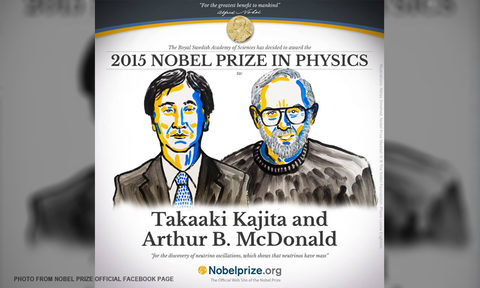

LONDON (CNN) — Two scientists have won the Nobel Prize in physics for groundbreaking work showing that neutrinos — subatomic particles — have mass, contrary to what had been thought.
The prize was awarded to Takaaki Kajita and Arthur B. McDonald, the Nobel committee said, “for the discovery of neutrino oscillations, which shows that neutrinos have mass.”
Kajita works at the University of Tokyo, in Kashiwa, Japan. McDonald works at Queen’s University, in Kingston, Canada.
Last year’s winners were two scientists in Japan and one at the University of California at Santa Barbara for helping create the LED light, a transformational and ubiquitous source that now lights up everything from our living rooms to our flashlights to our smart phones.
Since 1901, the committee has handed out the Nobel Prize in physics 108 times. The youngest recipient was Lawrence Bragg, who won in 1915 at the age of 25. The oldest physics laureate was Raymond Davis Jr., who was 88 years old when he was awarded the prize in 2002.
John Bardeen was the only physicist to receive the prize twice, for work in semiconductors and superconductivity.
In the coming days, the prize committee also will announce prizes in chemistry, literature, peace, and economics.
On Monday (October 4), three scientists shared the Nobel prize for medicine for their work on parasitic diseases.
Swedish industrialist Nobel created the prizes in 1895 to honor work in physics, chemistry, literature, and peace. The first economics prize was awarded in 1969.
This story was first posted on CNN.com, “Scientists from Japan, Canada win Nobel Prize in physics”