
(CNN) — What should be a day of celebration is now tempered by grief as millions of Muslims mark the final day of Hajj without hundreds of fellow worshippers.
It’s supposed to be a day of elation, the end of an annual journey to Mecca that many wait their entire lives for.
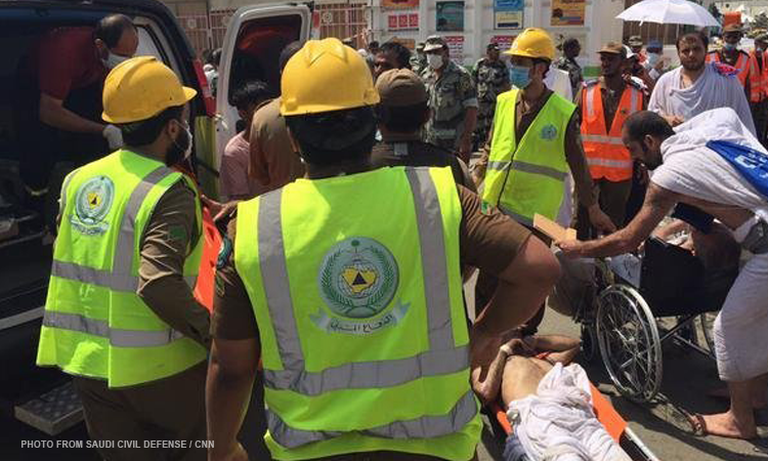
But this year’s Hajj is marred by the deaths of at least 717 people, killed in a stampede near the holy city of Mecca.
Saudi officials say they’re investigating what caused hundreds of pilgrims to get trampled Thursday (September 24).
Among the suggested causes: rushing to complete the rituals, extreme heat, throngs of worshippers pushing against one another in opposite directions, even confusion among the many first-timers on the annual Islamic pilgrimage.
Here’s the latest on what we know:
Where they came from
More than 2 million people from around the world arrived in Saudi Arabia for this week’s Hajj, a pilgrimage that all Muslims who are physically and financially capable of must make at some point in their lives.
And the 717 who died came from more than a dozen countries.
At least 136 Iranians were among the dead, and 340 remain missing, state-run Iranian TV reported Saturday.
India reported 18 of its citizens died, as did Egypt.
Pakistan reported nine deaths; Somalia, eight; Senegal, five; Turkey, four; and Kenya and Algeria, three each.
Indonesia and Nigeria each reported two deaths, and the Philippines and the Netherlands each reported one.
And there’s more anxiety from loved ones.
The Muslim Council of Wales said it had heard from only two of six tour groups that had traveled from south Wales for the Hajj. Together, the groups number about 250 pilgrims, council official Saleem Kidwai said.
He said families are “very anxious, very concerned.”
Too many people, too little time
The millions of pilgrims must perform a litany of rituals in five days, including the symbolic stoning of the devil in Mina, about 2 miles away from the Mecca holy site.
That’s where the deadly stampede took place Thursday, the third day of the five-day event.
Hajj pilgrim Ethar El-Katatney, a journalist and blogger, said the pressure to finish in time may have contributed to the stampede.
“There’s so little time to complete the rituals,” she said.
On top of that, worshippers were trying to push their way in opposite directions — some headed to the site of the stoning, some coming back from their previous ritual.
“Heavy pushing ensued,” pilgrim Ahmed Mohammed Amer said. “I’m at a loss of words to describe what happened. This massive pushing is what caused the high number of casualties among the pilgrims.”
Extreme heat and exhaustion
The journey is physically grueling enough on its own.
But with temperatures soaring over 43 degrees Celsius (110 degrees Fahrenheit), anyone who succumbs to the elements might collapse and never recover, El-Katatney said.
“But regardless, people were still continuing to … their ritual, where the stampede happened.”
El-Katatney said she talked to some of the men who were caught in the mayhem.
“They told me how if you fell, if you weren’t strong enough to withstand the pushing and shoving … if you fell, you weren’t going to get up again.”
Inexperience and confusion
Even though Saudi officials are extremely versed in hosting Hajj crowds, many of the pilgrims are making the journey for the first time and might not be prepared to follow all directions or handle the chaos.
“If any mistake happens — if a group makes the wrong turn — that will cause a disaster,” Jamal Khashoggi of Saudi Arabia’s El Arab TV told CNN. “And that’s exactly what happened.”
Maj. Gen. Mansour Al-Turki, the Saudi Interior Ministry’s security spokesman, hinted that the problem may have stemmed from some pilgrims not following established guidelines, the Saudi Press Agency reported.
And novice pilgrims might try to “go on their own, or try to take a shortcut,” Khashoggi said.
But Iranian officials accused Saudi officials of mismanaging the event.
And Hezbollah leader Hassan Nasrallah told Lebanese al-Manar TV that Saudi Arabia should let the management of the pilgrimage be a joint Muslim issue or allow a Muslim committee to supervise its management.
A deadly history
Hundreds of other pilgrims have been killed during the same ceremony in years past. But Thursday’s disaster was the deadliest at Mina since 1990, when 1,426 people died.
After a stampede during Hajj killed 363 people in 2006, the Saudi government erected three massive pillars and completed a $1.2 billion, five-story bridge near the site where pilgrims can toss stones.
But after the latest mass tragedy, many are wondering what more can be done to prevent another disaster.
CNN’s Merieme Arif, Yousuf Basil, Hamdi Alkhshali, Pierre Meilhan and Robyn Kriel contributed to this report.
This story was first published on CNN.com, “Last day of Hajj shadowed by grief, death investigations”