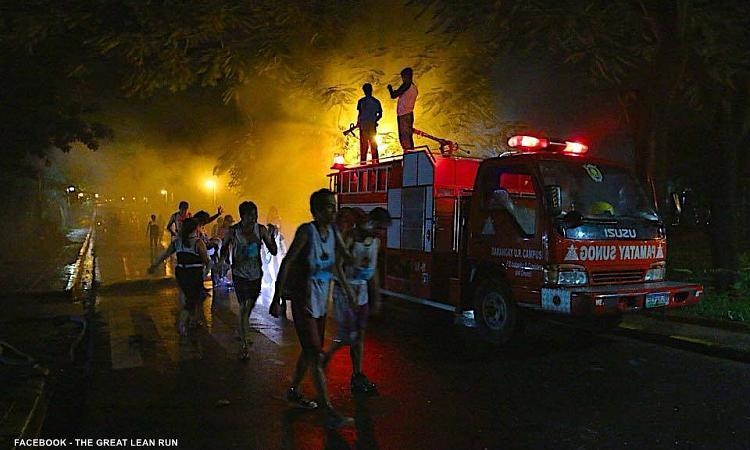

Metro Manila (Reuters) — A race at the campus of the University of the Philippines in Diliman, Quezon City on Saturday (September 19) gave participants a taste of what it’s like to be in a street protest with mobs, barricades and riot police.
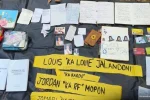
The race was called “The Great Lean Run” in honor of Lean Alejandro, an activist student leader from UP who was assassinated on September 19, 1987.
Hundreds of participants ran along a two-kilometer field, climbing over wooden barricades, crawling under barbed wire, and crossing muddy slopes while attempting to dodge mobs of mock policemen and rioters in a protest-inspired race.
Smoke machines and water cannons were used to distract the runners, simulating violent dispersal scenarios commonly used by authorities.
While mobs cannot physically hurt the runners with their baton or machete props, they can take the flags attached at the belt of the runners to “arrest” them.
Participants were out of the race if their three flags, signifying their “rights and freedom,” are taken by the mobs.
Organizer Susan Villanueva said the obstacle race was meant to educate the younger generation about the value of human rights and the history of the Philippines while it was placed under martial law in the 70s.
“That’s why it’s an unusual run. So in the run they are confronted with the fact that their rights could be taken at any moment with no notice, with no remedy, and that was what the Philippines was under martial law. So we’re recreating the conditions in order to make a point,” she said.
For Sophia Gallardo, 14, who has not experienced any violent protests, the race was both enjoyable and an eye-opener.
“Despite slipping in those muddy areas, that feeling like you survived martial law’ in the form of a race makes it worthwhile. I’m also proud that I still have all three flags in my lifeline belt,” she said.
The race was inspired by the 43rd anniversary of martial law in the Philippines where activists claimed that thousands of human rights were violated under the dictator rule of President Ferdinand Marcos.
Marcos declared martial law on September 21, 1972, and stayed in power until a popular uprising ousted him 14 years later.
He was accused of ordering extrajudicial killings, torture, forced disappearances and human rights violations during his rule. He was never convicted and thousands of complainants are still waiting for restitution, in court cases still to be resolved.
The current Philippine Constitution, drafted in Corazon Aquino’s administration, dictates that martial law and suspension of civil rights cannot exceed 60 days unless Congress votes otherwise.