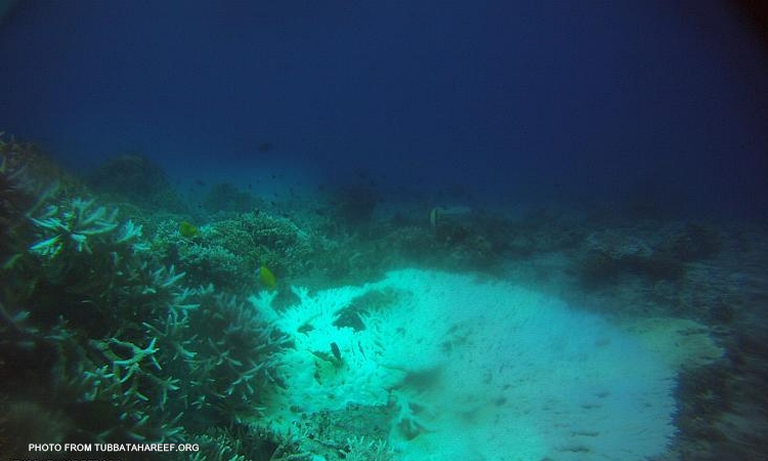

Puerto Princesa City (CNN Philippines) — El Niño has started taking its toll on Tubbataha Reefs Natural Park, where marine some coral bleaching has been observed to be developing in some areas since last July.
The patches of bleached coral in part of the North and South Atolls could be considering “alarming,” Jeric Dejucos, research assistant at the Tubbataha Management Office (TMO), told CNN Philippines on Monday (September 14).
“The fact na meron tayong bleaching, whether maliit o malaki ito sa ngayon, talagang masasabi nating alarming iyon,” Dejucos said.
[Translation: “The fact that there is bleaching, whether covering a small or big area, we can say that the situation is alarming.”]
Bleaching — or whitening — of corals happens when they start ejecting the algae, the organisms on which they depend not only for food but also for their brilliant colors, according to Dejucos.
They eject the algae, which they otherwise live in close harmony with, when they get stressed. And one thing that stresses them is hot weather and high water acidity.
As the corals eject the algae, called zooxanthellae, become undernourished.
“We aren’t sure if it has affected the whole Tubbataha,” Dejucos said. “But in the dive sites we visited early September, we are sure.”
Of those sites visited, he added that areas covering about 0.006 to 0.009 percent of every 25 square meters have been affected.
Bleached corals are not yet dead, he pointed out. But they are now susceptible to disease, which may kill them.
“Kapag nagkaroon ng bleaching, di pa natin sinasabing mamamatay agad ang corals. Pero kapag napatagal ang panahon na may anomaly sa water temperature ay malalagay sa alanganin ang corals. Eventually, mamamatay din ito,” he said.
[Trnanslation: “When there’s bleaching, we cannot say that the corals will die immediately. But if there’s an anomaly in the water temperature for a long time, the corals will be at risk. Eventually, they will die.”]
In a report posted on tubbatahareef.org, TMO said bleaching was seen on dive sites called Amos Rock to South Park and in areas around the Bird Islet in the North Atoll. In the South Atoll, the same signs were observed on Black Rock to Delsan Wreck and also on Jessie Beazley Reef.
“Affected corals were mostly in branching and tabular form and occurs at different depths,” the TMO report says. “More recent reports reveal that some of the bleached corals are now overgrown by algae, indicating that several weeks have elapsed since the occurrence.”
The Tubbataha Reefs Natural Park is a 97,030-hectare marine protected area (MPA) 150 km southeast of Puerto Princesa City.
In 1988, President Corazon Aquino declared it as a national marine park — the first of its kind in the country.
It was, however, not spared when the country experienced major bleaching events in 1998 and 2010 El Niño episodes.
But according to the TMO, the corals have recovered well because of its protected status.
This time, however, there’s a big chance that the situation may worsen, with the El Niño predicted to last until 2016.
What the TMO can do, Dejucos said, would be to increase the resilience of the reef by focusing on controllable factors, such as illegal fishing, which may aggravate the situation.