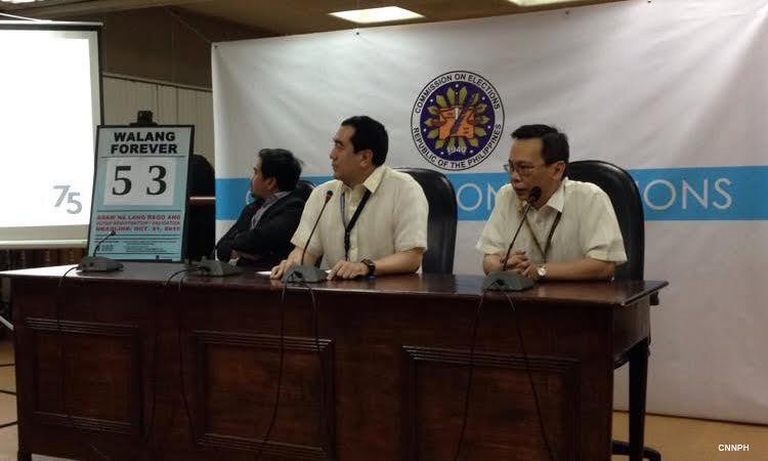

Metro Manila (CNN Philippines) — The Commission on Elections (Comelec) said on Tuesday (September 8) that political parties, poll watchdogs and concerned citizens may soon review the source code submitted by Smartmatic.
Starting October 1, the public may examine the base source code that serves as the blueprint of the software that will run the Optical Mark Reader (OMR) machines in 2016 presidential elections.
It is the electronic “script” that the OMR machines will follow in handling the data – the votes or the results of the elections.
Comelec Chairman Andres “Andy” Bautista noted that they have allotted eight months to review the source code, which is longer than in previous elections.
Bautista said allowing the public to review the source code is the poll body’s way of assuring them that the automated election system will be fair and accurate.
“I think it is also the responsibility of Comelec to educate, to try to get people to understand the process because if we build confidence in the process then I think it will be more accepted,” Bautista told reporters.
Reviewers shall be on the lookout for so-called “malicious lines” in the code which may prevent the machines from properly scanning ballots and counting the votes.
According to Comelec, De La Salle University has agreed to host the base source code review in its campus along Taft Avenue in Manila. The university will be providing all facilities for the activity for free.
Comelec to use some old PCOS machines
There will be use for the old Precinct Count Optical Scan (PCOS) machines in 2016 after all – some of them at least.
The Comelec decided to have 5,000 to 10,000 PCOS machines cleaned, to be used in special voting sessions for persons with disability and local absentee voting.
Comelec Commissioner Rowena Guanzon said they will work with the Department of Science and Technology (DOST) in diagnosing the 81,896 PCOS machines used in the 2010 and 2013 polls to see which of them can be used in 2016.
“They’re very optimistic that many of these machines can still work. But it’s just that we have to try,” said Guanzon.
The government had spent roughly P9 billion to lease and buy the old PCOS machines from Smartmatic.
Then last month, Comelec decided to lease new machines for about P8 billion due to the lack of time to refurbish the old ones – as advised also by Smarmatic.
Guanzon concurred with that decision but criticized Smartmatic for allegedly “cornering” them into choosing the more expensive option of leasing new machines instead of refurbishing the old ones.
“The commission en banc just decided that, okay, now that we’re not pressed for time, we’ll give it a go,” Guanzon said.
The Comelec also clarified reports that they had bid out the ballot-printing deal to Smartmatic.
According to Comelec, the National Printing Office will be printing the ballots for 2016.
Raising teachers’ pay for the elections
The Comelec said it is in favor of raising the monetary allowance public school teachers receive for serving as board of election inspectors (BEI’s).
Comelec Chairman Bautista, however, said it will depend on whether Congress will increase the poll body’s budget for the 2016 elections.
Teachers received P4,500 in the 2013 elections and Bautista said the Budget Department has set the same amount for next year’s polls.
Bautista said he hopes to get support from lawmakers in raising election duty pay of public school teachers.
“We are looking for ways and means by which we can increase it,” Bautista said.
Buhay Party-list Representative Lito Atienza earlier proposed to raise the amount to P8,000, which may include insurance coverage and legal funds.
“Hopefully if Congressman Atienza can convince his colleagues to increase it, we are all for it. We are all for the increase of the allowances of our teachers,” said Bautista.