
Las Nieves, Agusan del Norte (CNN Philippines) — Emergency peace talks mediated by civilian and military authorities, along with some religious leaders, on Saturday (September 5) prevented a brewing tribal feud from erupting into a bloody conflict in Barangay Lawan-Lawan in Las Nieves, Agusan del Norte.
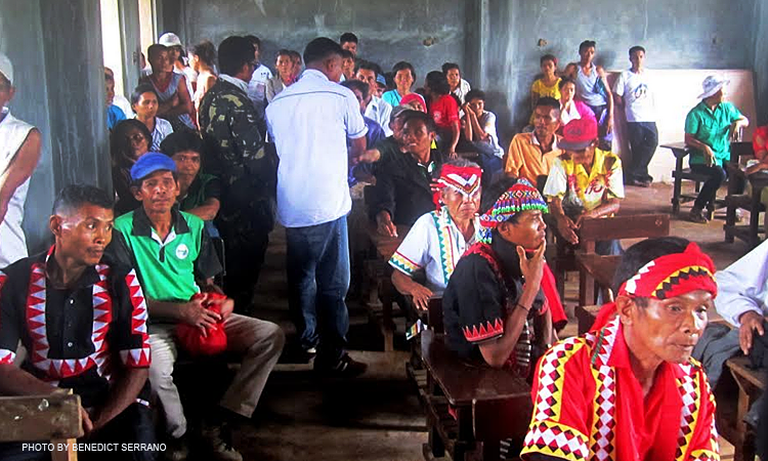
Feuding leaders of Higaonon tribe were able to reach a peace pact after a dialogue that lasted from 9 a.m. to noon at the Lawan-Lawan Integrated School. Some 200 residents of the area attended the dialogue.
Col. Alexander Macario, commander of the 401st Infantry Brigade, acted as moderator.
One side was represented by Eddie Ampiyawan, also known as Datu Bawang, who is chairman of both the Higaonon Water System Association (HIWASA) and Higaonon Livelihood Association.
The other side was represented by Datu Ronald Manhomosay, who is now indigenous peoples’ representative to the Las Nieves Municipal Council, and Lawan-Lawan Barangay Chairman More Migduyan.
The trouble started with tribe members accusing each other of being supporters of either the New People’s Army or the military.
But towards the end of their dialogue they were teary-eyed as they held hands and embraced each other and posed for photographs.
They vowed that instead of fighting each other, they would fight the common enemy — poverty, which has lead to illiteracy and underdevelopment of their communities.
In his speech, Macario told participants of the dialogue that the 401st Infantry Brigade would like to turn Lawan-Lawan into bastion of peace and development not of insurgents.
He explained that Lawan-Lawan has strategic mountain ranges connecting the provinces of Misamis Oriental, Surigao del Sur, Agusan del Norte, and Agusan del Sur. So, from the early 80’s up to the late 90’s, the barangay was a bastion of communist insurgents.
“Maraming namatay dito noon from both NPA and military forces dahil sa mga ambush,” he said. “Minsan naging no man’s land nga itong Lawan-Lawan dahil sa bakbakan noon eh.”
[Translation: “Many from both the NPA and military forces died here because of ambushes. Lawan-Lawana was once a no man’s land because of the fighting.”]
He urged Lawan-Lawan to turn their efforts into planting vegetables and fruits, along with coffee and cacao.
“This place is very ideal for these crops, according to studies made by agriculture and soil experts,” Macario said.
He pointed out that the barangay is a huge plain on top of a mountain range.
“I like your cool weather here,” he said. “It is clean, cool air all throughout.”
For their part, the Higaonon leaders appealed to the national government agencies to help them with projects to alleviate poverty in their area.