
Metro Manila (CNN Philippines) — A planned transfer of renegade policeman Rizal Alih to a detention cell in Taguig might have led to an emotional breakdown which caused his death by heart failure last Friday (August 14) in his cell in Camp Crame, Quezon City.
Hadja Leah Alih, the ex-policeman’s sister, made this statement in an interview on Sunday (August 6), day after the burial of her brother at a public cemetery in Zamboanga City.
According to her, before her brother died, he complained to her about being transferred to a detention cell in Taguig. No reason was given for the transfer.
She said the planned transfer, which Rizal reportedly worried about, might have led to his heart failure last Friday.
Leah reportedly received the call about her brother’s transfer Thursday dawn, a day before her brother died of heart failure at the age of 69. He would have turned 70 on December 30 this year.
Rizal Alih’s body was flown to Zamboanga City aboard a commercial airliner, which ironically was the same plane taken by Zamboanga City Mayor Maria Isabelle Climaco Salazar.
Salazar is a niece of the late Mayor Cesar Climaco, whose assassination on November 14, 1984 authorities pinned on a Muslim group allegedly led by Rizal Alih.
Police detained Alih and some of his men n connection with the assassination at Camp Cawa-Cawa in Zamboanga City.
On January 5, 1989,, Alih reportedly had a heated argument with Brig. Gen. Eduardo Batalla, regional commander of what was then the Philippine Constabulary-ON JanuuaIntegrated National Police (PC-IINP). Alih was arguing against an order to have him detained in Metro Manila.
The argument turned into a shouting match that prompted Alih and his men to take Batalla hostage, along with his chief of staff, Col. Romeo Abendan.
The three-day hostage-drama ended with government troops assaulting the camp. Batalla and Abendan died in the assault, allegedly shot by Alih, who was able to escape to Sabah.
In 1994, Malaysian authorities arrest Alih there for illegal possession of weapons and munitions. A court sentenced him 12 years in. He was handed over to the Philippine authorities in 2006.
Since then he had been detained at the Philippine National Police Headquarters in Camp Crame, where he died of a heart attack on Friday.
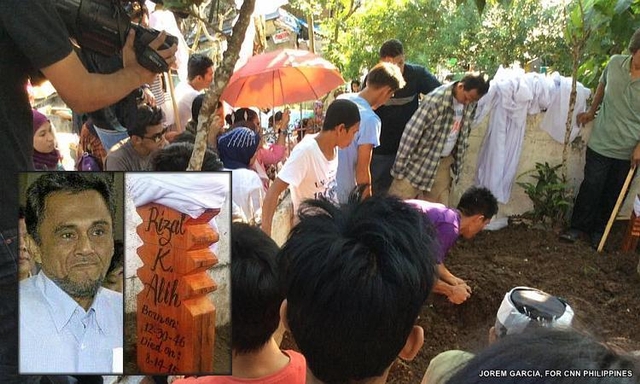
On Saturday, his body was brought to the family home in Lower Calarian in Zamboanga City, where Islamic rites administered.
Alih was then laid to rest alongside his brother and near the plot of his parents at the Caragasan Cemetery Saturday afternoon in accordance with the Islamic tradition of burying the dead before sundown.
Family, friends and supporters accompanied the body to its final resting place.
Hadja Leah Alih said her brother’s last wish was to be buried in Zamboanga City.
Alih left 24 children from five wives. One of his spouses had passed on before him.