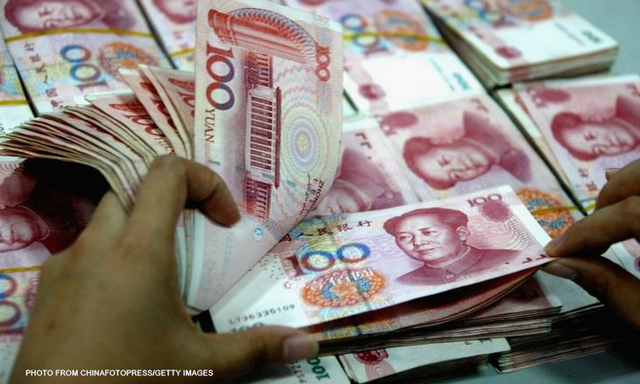

Metro Manila (CNN Philippines) — Filipino workers overseas might have a harder time sending the same amount of money back home, following the largest drop in the Chinese yuan in two decades.
On Wednesday (August 12), Chinese central bank allowed its currency to drop for a second day in a row. The yuan fell by by 1.6 percent, following Tuesday’s 1.9-percent drop.
Bangko Sentral ng Pilipinas (BSP) Monetary Board member Felipe Medalla said that the yuan’s fall could be mirrored by other currencies.
“One possibility is the currencies of many other countries will start to follow suit. So in this case, the workers in those countries may have to work a little bit harder to remit the same number of dollars or pesos.”
Beyond overseas remittances, the head of an equities firm said that the devaluation has also sent ripples in stock markets around the world.
“For the stock market, it’s more like a sentiment-driven effect. The way that it affects other countries in the region and America is probably the same thing. That’s why we’re a bit lower today, explained Joey Roxas, president and chief analyst of Eagle Securities.
On Wednesday, the Philippine Stock Exchange Index shed 75 points and closed at 7,495.43 points.
Wall Street also saw red on Tuesday. The Dow shed 212 points, the Nasdaq lost 65 points, and the S&P500 fell by 20 points.
But Medalla said that there’s a bright side for Filipino consumers, as the Philippines imports more than it exports to China.
“Weaker China means lower oil and commodity prices — which we import. This may actually mean that the low oil prices may remain longer for quite some time. So actually, from the point of view of the Filipino consumer, this is probably largely good news.”
Medalla said that it’s possible the devaluation reflects slower economic growth in China.
This would have chilling consequences around the world, as many economies depend heavily on China’s exports and manufacturing sector.
But he added that in case this happens, the Philippines can weather the storm.
“The Philippines is in a better position to respond, because number one, we have very stable macroeconomy. We have a very manageable fiscal budgetary situation, and we have a very large current account surplus.”
The Chinese central bank can either further weaken or strengthen the yuan. Meanwhile, the rest of the world can only wait for China’s next policy move — and deal with the consequences.