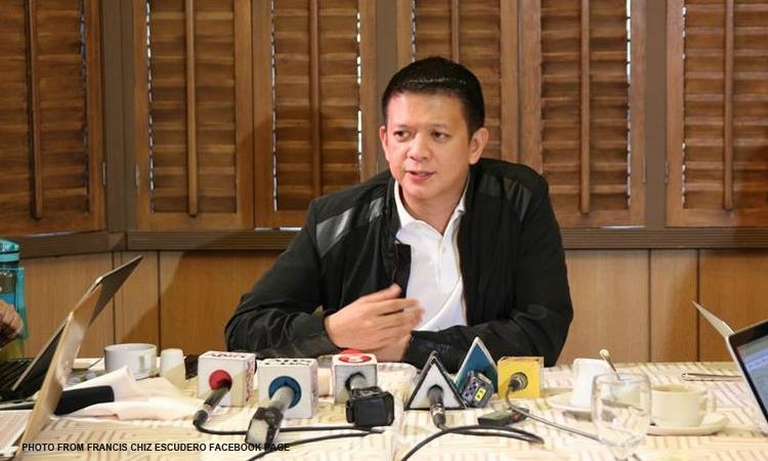

Lawmakers should insist on asking this question, Sen. Francis Escudero said in a statement issued on Sunday, August 9.
“It is only right to attach ‘measurable performance’ to every peso that the DOTC is asking in taxpayers’ money to subsidize the rail operations,” Escudero said.
In its budget request, the DOTC plan to spend some P15.7 billion to address the problems plaguing not just the Metro Rail Transit (MRT) but also the Light Rail Transit (LRT), and the Philippine National Railways (PNR).
According to Escudero, the DOTC said 41% of its proposed budget would be earmarked for the rail sector. For the MRT alone, this would supposedly allow it to to field more trains, shorten passenger queues, and start long-delayed projects.
Promises to keep
Escudero questioned on each of those promises.
“The DOTC says it will speed up transfer time in stations from 10 minutes this year to 5 minutes next year,” Escudero said. “Ang una ngang dapat itanong: 10 minutes nga lang ba ang waiting time sa MRT ngayon?“
[Translation: The first thing we should ask is: Is is true that the waiting time at the MRT is just 10 minutes?]
The DOTC also vowed, he said, to cut overloading in MRT trains from 171% to 157%.
“Is this decrease in load factor doable or drawing lang? Ilang bagong train ba ang parating para masabi natin na maiibsan na ang siksikan?“
[Translation: Is this decrease in load factor doable or an unachievable projection? How many new trains are arriving so that we can say that crowding will ease up?]
According to Escudero, the DOTC is asking Congress to appropriate P7.09 billion in MRT-related expenses, broken down as follows:
P1.96 billion for operation and maintenance
P1.5 billion for rehabilitation and capacity expansion
P3.63 billion as subsidy for “mass transport”
The last amount, Escudero explained, would supposedly cover deficiencies in “settling prior and current years’ obligations for equity rental, maintenance fees and others obligations” in case “farebox revenues” are insufficient to cover those.
Other lines also need scurtiny
Escudero said Senate should not focus on the MRT alone, saying: “Senate’s strict scrutiny of rail-related appropriations should extend to other lines kasi hindi lang naman sa MRT mahaba ang pila at may aberya ang mga tren.”
[Translation: Senate’s strict scrutiny of rail-related appropriations should extend to other lines because it’s not just the MRT that has long lines and that has trouble with its trains.]
The PNR, he pointed out, had asked for P1.32 billion in operating subsidy for 2016, with a performance guarantee to provide “safe and reliable rail services for the Metro South Commuter Services.,”
That refers to the line running from Tutuban in Manila to Calamba in Laguna.
For the Light Rail Transportation Authority (LRTA), the requested subsidy is P1.42 billion, with the agency promising to field one train every 3 to 4 minutes during peak hours in its Roosevelt-Baclaran Line 1 and one every 5 to 6 minutes in its Pasig-Recto Line.
“Kaya dapat itong mga pangakong ito ilagay sa tarpaulin sa bawat istasyon, because these promises are not just made to Congress but to taxpayers who, by their payments, fund the national budget,” Escudero said.
[Translation: These promises should be printed on tarpaulin mounted at each station because these promises are not just made to Congress but to taxpayers who, by their payments, fund the national budget.]
The DOTC also requested a P6.75 billion “construction budget” for various LRT extension projects, such as P1.62 billion for the LRT Line 1 Cavite Extension Project and P2.9 billion for the LRT Line 2 Extension Project.
Escudero noted that the P43.5 billion proposed budget of the DOTC did not include subsidies to state corporations.
Metro Manila (CNN Philippines) – Can the Department of Transportation and Communications (DOTC) fulfill its pledge to improve the country’s train systems with its P43.5 billion budget request for 2016?