
(CNN) — It was a breakthrough in the mystery of MH370 when the Malaysian Prime Minister on Wednesday (August 5) confirmed that a part of an aircraft wing that washed up on Reunion Island in fact belongs to the missing plane.
Prime Minister Najib Razak did not equivocate: “It is with a heavy heart that I must tell you that an international team of experts have conclusively confirmed that the aircraft debris found on Reunion island is indeed from MH370.”
The search for the plane is an international effort, but Najib – as the leader of the country where the flight originated – should be a source as informed as anyone.
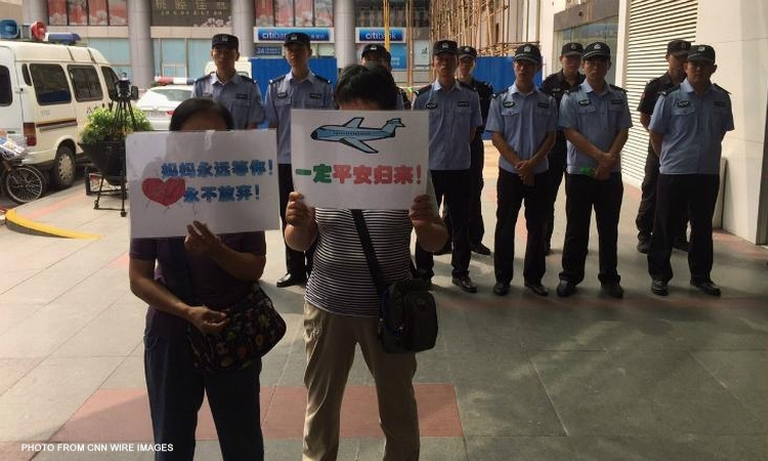
So, why have some of the victims’ families reacted with skepticism, and even anger at the Malaysian announcement?
“I don’t believe it,” one family member told CNN. “This announcement is very irresponsible.”
The Malaysian government has been wrong before when it comes to the hunt for Malaysia Airlines Flight 370.
The doubts only deepened after the French team inspecting the debris said more tests are being done to be completely certain.
Another family member said: “The families want 100% confirmation. ..that means Boeing company and the French investigators. We don’t want 99%. Malaysian authorities have been trying to force a closure ….for themselves, not for the families.”
What missteps have Malaysian authorities made since MH370 disappeared on March 8, 2014, with 239 people on board? Critics have highlighted several in their early response.
Accusations of errors, incompetence
Malaysian military radar captured signatures of what was believed to have been Flight 370, but it wasn’t immediately noticed.
While the radar data was the key reason for expanding the search west of Malaysia, it took officials until March 11 – three days after the disappearance – to explain why they were looking so far off the plane’s expected course. All the while, search efforts continued in places where data showed it could not have been – the Gulf of Thailand and the South China Sea.
A report issued a month after the plane’s disappearance also highlighted snafus in crucial communication between air traffic control centers and Malaysia Airlines on the morning Flight 370 disappeared.
These kept officials from realizing the airplane had gone hundreds of miles off course for several hours and delayed attempts at finding it.
Failure to share information
China and some U.S. officials expressed frustration over what they said was Malaysia’s initial failure to share information or accept more offers of help.
“Time is life,” said a Chinese Foreign Ministry statement, eight days after the plane’s disappearance.
The lack of concrete information created plenty of space for speculation and conspiracy theories to run rife. Was the plane hijacked? Could terrorism have been involved? Was the plane in fact brought down somewhere on land?
Relatives told ‘no survivors’ by text message
Malaysia Airlines and the Malaysian government incurred the wrath of many relatives when, 16 days after the disappearance, they were sent a text message telling them the plane was believed lost in the southern Indian Ocean “and that none of those on board survived.”
The airline defended its approach, saying it was keen to make sure that the families heard the news before it was shared with the rest of the world by the Malaysian Prime Minister.
But relatives said a text message was no way to convey such terrible news.
Then, within days – after family members had angrily blasted the conclusion as premature and lacking hard evidence – acting Minister of Transport Hishammuddin Hussein told reporters that he had not entirely given up hope of finding survivors.
“Even hoping against hope, no matter how remote, of course, we are praying and we will continue our search for the possible survivors,” he said.
Error over last words from cockpit
People’s trust was also undermined by other inconsistencies in what the government said.
On March 17, Malaysian authorities publicly confirmed the final words from the cockpit as “All right, good night.”
The innocuous bit of radio banter became yet another headache for investigators when, after days of prodding from reporters and family members, they released a transcript showing the final words were actually, “Good night Malaysian three seven zero.”
It’s not that the new language was suspect – it’s not. It’s that Malaysian officials got the original wording wrong, let it stand for nearly two weeks, and then – after saying they wouldn’t release the transcript because of its role in the investigation – suddenly reversed course.
Officials also wavered over whether the words were spoken by co-pilot Fariq Abdul Hamid or pilot Zaharie Ahmad Shah, before finally saying it was the latter.
Doubts over evidence, transparency
From the beginning, the families of those missing complained of a lack of information and transparency from the Malaysian government and Malaysia Airlines.
Early briefings were chaotic, leading some to question who was in charge. Angry relatives accused authorities of deliberate search delays and cover-ups.
In the first hours after the plane disappeared from radar screens, not long after it left Kuala Lumpur’s international airport, the Malaysian government acknowledged that it had no idea where it had gone.
Relatives slammed the airline’s updates as infrequent and its support as inadequate, including an offer of $5,000 immediate financial assistance to each family member.
This story was first published on CNN.com, “How Malaysia missteps on MH370 eroded families’ trust.”