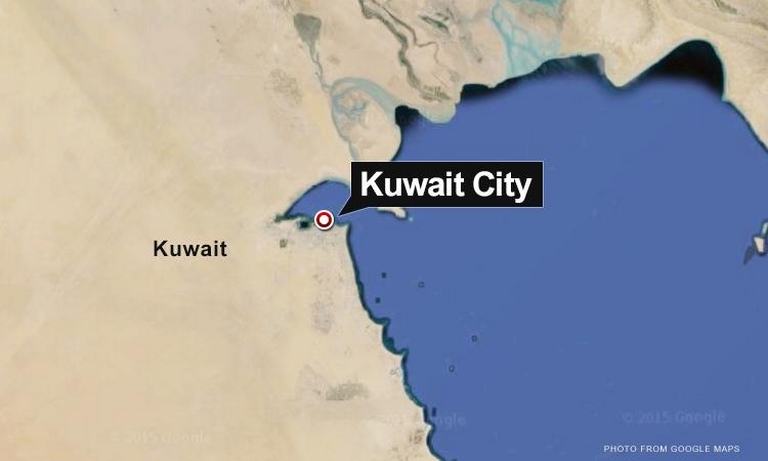

(CNN Philippines) — At least 25 people were killed and more than 200 worshippers were injured in an attack on a mosque in Kuwait City on Friday (June 27), the first attack of its kind in the major oil-exporting country, according to reports.
A suicide bomber blew himself up inside a packed Shi’ite Muslim mosque during prayers, the interior ministry said.
A CNN.com report said the Islamic State militant group or ISIS claimed responsibility for the attack in the district of Sawaber, the eastern part of the Kuwaiti capital.
The group named the bomber as Abu Suleiman al-Muwahed and said in a statement posted on social media that he had targeted a “temple of the rejectionists” – a term it generally uses to refer to Shi’ites, whom it regards as heretics.
No words on Pinoys yet
Meanwhile, no Filipinos were reported hurt or killed in the blast so far, according to Philippine Ambassador to Kuwait Renato Pedro Villa during a phone interview with CNN Philippines’ Nightly News.
Villa said the Emir of Kuwait has already ordered a thorough investigation of the incident, adding that the Philippine consul general is already at the site coordinating with Kuwaiti officials to determine if any Filipinos were affected.
Yaqoub Al-Sanea, Kuwait’s Justice and Islamic Affairs minister, called the attack “a terrorist and criminal act that threatens our security and targets our national unity.”
Security forces has quickly sealed off the perimeter of the mosque while rescue workers carried the wounded to hospital.
Shi’ites comprise between 15 and 30 percent of the predominantly Sunni Muslim Gulf Arab state, where members of both communities are known to live side by side with little apparent friction.
The Kuwait mosque bombing was one of the three terrorist attacks Friday that also struck France and Tunisia.
The U.S. State Department said there was no evidence so far that the three terrorist attacks were coordinated.
State Department spokesman John Kirby said the attacks were still being investigated but there was “no indication on a tactical level they were coordinated.”
“Obviously, clearly, they were all terrorist attacks,” Kirby said at a news briefing.
At least 37 people at a Tunisian seaside resort were killed while one person was decapitated at a U.S. gas company in France as a result of the attacks.
The attacks occurred during the Islamic holy month of Ramadan.
Islamic State had urged its followers on Tuesday (June 23) to step up attacks during the Ramadan fasting month against Christians, Shi’ites, and Sunni Muslims fighting with a U.S.-led coalition against the ultra-hardline jihadist group.
“I don’t believe investigators are at a level now that they know precisely what motivated each one of these and the degree to which Ramadan itself was a factor,” Kirby said. “It’s just too soon to tell right now.”
CNN International and Reuters contributed to this report.