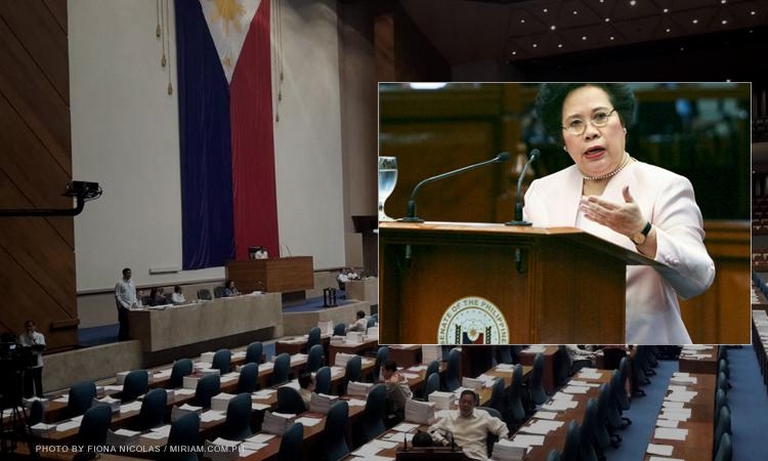

(CNN Philippines) — A day after supporters of the creation of a Bangsamoro entity hailed the passing of a substitute bill at the House of Representatives, Sen. Miriam Defensor-Santiago weighed in on the matter and said that the proposed measure was teeming with “constitutional infirmities.”
Santiago, who chairs the Senate Committee on Constitutional Amendments, said on Thursday (May 21) that the proposed Bangsamoro Basic Law (BBL) — which has been renamed as the Basic Law of the Bangsamoro Autonomous Region (BLBAR) — aims to create a sub-state that would be co-equal with the national government and in clear violation of the Constitution.
Changing the name, Santiago pointed out, would not make it any less objectionable. Same dog, different collar.
She took exception to the words “basic law,” which is legal parlance is synonymous with “organic law” — put simply, a constitution or charter.
“It goes without saying that two different constitutional instruments cannot have legal effect at the same time and in the same territory.”
The lawmaker, who is among the foremost constitutional experts in the Senate, explained that the new version had provisions that can only be approved with a constitutional amendment.
However, Santiago warned that doing so — revising the Constitution instead of amending the proposed law — would be “constitutional impiety.”
“The proposed BBL must be consistent with the provisions of the Constitution of the Philippines,” she said. Not the other way around.
“The committee on constitutional amendments appreciates the brilliant efforts of the hardworking men and women who put the BBL together. However, in its present state, the BBL raises many insidious doubts on constitutionality.”
Santiago said that among the objectionable provisions that the House ad hoc committee introduced tamper with issues on sovereignty, autonomy and territorial integrity.
Another contentious issue, which members of the House Minority raised, was the “opt-in” provision which allows areas outside the core Bangsamoro territory to join the region if 10% of their constituents petition for it and if approved by a majority in a plebiscite.
Thus, in a 27-page committe report, the Ilongga lawmaker recommended that the Senate version of the bill be substantially be revised.
The document is one of three committee reports that will form the Senate’s position on the BBL effort. The two others will come from the Committee on Local Government — the primary committee — and the Committee on Peace, Unification, and Reconciliation.
Santiago added that she doubts that the proposed law, if enacted, will bring peace to Mindanao as the Moro Islamic Liberation Front (MILF) was not the only secessionist group active in the country.
Others include the older rebel group, Moro National Liberation Front (MNLF), the Bangsamoro Islamic Freedom Fighters (BIFF) and the Justice for Islamic Movement (JIM).
For his part, international security analyst Rommel Banlaoi warned that the creation of Bangsamoro region that would fail the people of Mindanao could make things worse.
Banlaoi said such a failed scenario can give other groups of Islamist extremists an opportunity to take advantage of the situation and join forces with the BIFF.