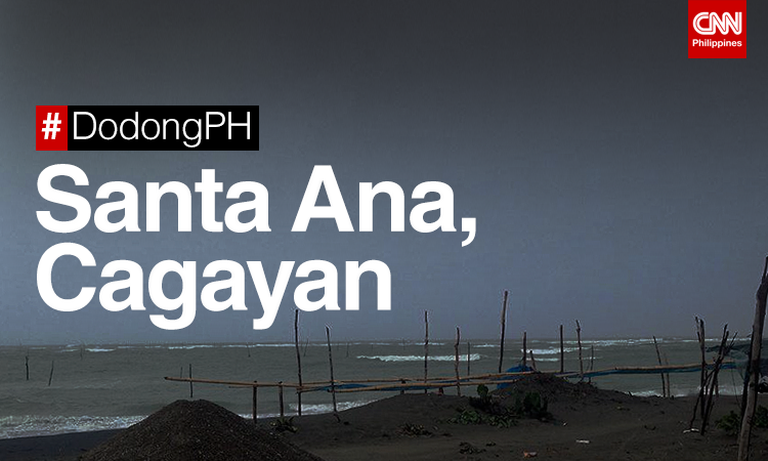

(CNN Philippines) – Typhoon Dodong (international name: Noul) has weakened as it move towards Balintang channel six hours after it made landfall in Cagayan province Sunday afternoon (May 10).
According to PAGASA’s 11 p.m. bulletin, Typhoon Dodong was slowly moving northwards at 16 kph when it was last spotted at 100 km northeast of Aparri, Cagayan at 10 p.m. Dodong is already out of the land mass and losing its speed and strength with maximum sustained winds of 160 kph near the center and gusts of up to 195 kph.
Dodong was packing super typhoon-like winds of up to 185 kph and gusts of up to 220 kph when it made landfall over Pananapan point in Sta. Ana, Cagayan province at 4:45 p.m. Sunday.
Its weakening form also prompted the state weather bureau to downgrade its public storm warning signals. As of posting time, only the following warning signals remain in effect:
Signal No. 3
Northeastern Cagayan
Batanes
Babuyan
Calayan Group of Islands
Signal No. 2
Rest of Cagayan
Apayao
Signal No. 1
Ilocos Norte
Kalinga
Abra
Northern Isabela
Typhoon’s wrath
Prior to its landfall, Dodong pounded the rice-producing province of Cagayan about 400 km (250 miles) north of Manila, with ferocious winds and torrential rains within the typhoon’s 100 km diameter, prompting PAGASA to warn local folks in parts of the Cagayan Valley of possible landslides and flash floods.
More than 1,200 residents from vulnerable areas were relocated earlier to evacuation centers. Affected families in the towns of Sta. Ana, Buguey, Sta. Teresita, Gonzaga, and Aparri were already evacuated less than two hours before Dodong made landfall.
Power was cut in Tuguegarao City, the capital of Cagayan province, on Sunday, a report from Reuters said.
The rough seas caused by the storm prompted many vessels ships to take shelter in ports, leaving more than 5,000 people stranded across the nation, according to the National Disaster Risk Reduction Management Council (NDRRMC).
Cebu Pacific cancelled at least six domestic flights to the north.
“We strongly advise preemptive evacuation while we still have time, and we expect there will be a confluence of events – a high tide, heavy rainfall in the mountains, the possibility of a storm surge and strong winds,” NDRRMC chief Alexander Pama told a news briefing before the typhoon hit land.
Provincial officials have alerted rescue units and positioned relief goods. Government trucks were also readied to ferry people away from low-lying and flood-prone areas.
Forecast positions:
• 24 hour (Monday evening): 240 km north-northeast of Basco, Batanes
• 48 hour (Tuesday evening): 940 km northeast of Basco, Batanes (outside PAR)
With its current speed and movement, Dodong will likely exit the Philippine territory by Tuesday morning (May 12) as it heads toward Japan.
“The weather is deteriorating quite rapidly. It’s obvious that the typhoon is moving in very quickly,” said storm chaser James Reynolds in Santa Ana hours before the typhoon made landfall.
Farmers wanted rain
Dodong entered the Philippines at a time when a volcano, Mount Bulusan, has been spewing ash in southern Luzon.
Farmers in Luzon had been hoping the storm would weaken while still providing much needed rains after a dry spell in the region, according to the charity World Vision.
But the storm has only got stronger and looks set to bring extreme amounts of rain to some areas.
Situated in a vulnerable part of the Pacific, the Philippines experiences an average of 20 typhoons a year, five of them destructive, according to the Asian Disaster Reduction Center.
CNN’s Jethro Mullen, Faith Karimi, Derek Van Dam, and Reuters contributed to this report.