
(CNN Philippines) — Regardless of ideology or form of economy, governments around the world share one thing in common: the power of taxation.
Whoever is in power has the right to tax — and modern governments have found ways to tax just about everything: inheritance, amusement, consumption, and even “sin.”
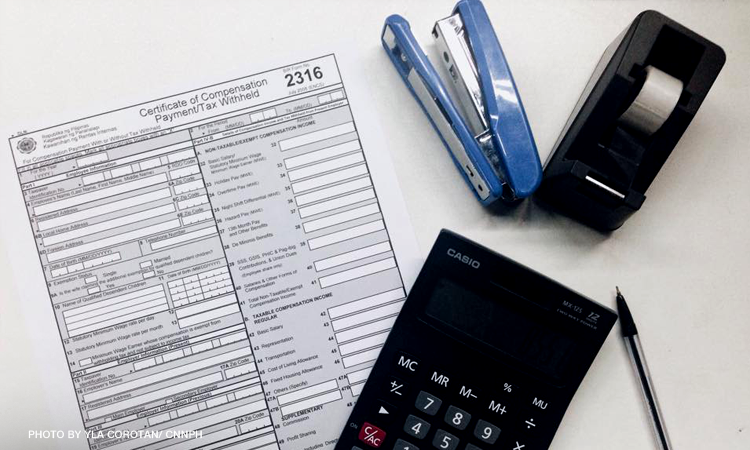
But the most direct — and arguably largest — levy that workers face is the income tax.
According to a 10-year study by the National Tax Research Council (NTRC), the income tax constitutes the largest share of the national government’s tax revenue.
Related: How to file income tax returns
From 2001 to 2010, income taxes consistently comprised no less than 43 percent of the total taxes collected by the government. The value added tax comes at a distant second, with a consistent share of no less than 21 percent over the same decade.
Despite the significance of income tax to the national government’s tax revenue, it’s been nearly 20 years since reform has taken place. The levy’s current schedule was established through the Tax Reform Act of 1997 (R.A. 8424) which amended the National Internal Revenue Code.
Read: BIR expands electronic filing system
The Philippine economy of 2015 is certainly different than that of 1997. And yet, income tax remains virtually the same.
R.A. 8424 provided for marginal changes, but such only concerned individuals in the highest incoming bracket — those who earn more than P500,000 a month. The law reduced their marginal rate from 34 percent in 1997 to 32 percent in 2000.
Tax reform
However, lawmakers have filed several bills seeking to reform taxation.
Senate Bill (SB) 716, filed by Sen. Ralph Recto in 2013, factors in the variable of inflation. In his explanatory note, Recto mentioned that “the rate of inflation of all commodity groups as measured by the consumer price index (CPI) from 1998 to May 2013 has almost doubled at 96%…”
Under Recto’s legislation, the tax brackets would be moved further upward.
For example, individuals earning P20,000 or less will constitute the lowest portion of the schedule, and will be charged just 5% of their income instead of the current P1,000 levy plus 10% of the excess over P10,000.
Likewise, the bill provides that the tax rates be adjusted every six years according to the CPI.
SB 1942, filed by Sen. Paolo Benigno “Bam” Aquino IV during the same year also makes use of a tax rate adjustment on a six year interval, based on the CPI.
However, Aquino’s bill exempts individuals earning no more than P60,000 from paying income tax. The legislation also moves the bracket further upward.
“The salary of a management level employee [sixteen] years ago will probably be equivalent to the salary of an entry level call center agent today because of inflation and other economic factors,” explained Aquino in a statement.
The most recent tax reform bill, SB 2149 filed by Sen. Juan Edgardo “Sonny” Angara last year, deviates from the previous two bills. In his explanatory statement, Angara stressed the importance of tax reform in preparation for the upcoming economic integration of the Association of Southeast Asian Nations (ASEAN).
“In order for the Philippines to attract human capital and to prevent the migration of our own, it is imperative that we reduce the existing income tax rates while maintaining the progressivity of our income tax system, as mandated by the 1987 Philippine Constitution.”
Likewise, he also explained that next to Thailand and Vietnam, the Philippines has ASEAN’s highest top income tax rate at 32%. Angara’s bill moves the schedule upward and reduces tax rates on all income brackets by 2017.
By that year, for example, those earning between P20,000 to P70,000 will be charged only 10% of their income.
Where do taxes go?
The Philippine’s Department of Budget and Management says that the country’s P3 trillion budget for 2016 will go to a myriad of sectors:
General Public Services: 41.7 percent
Economic Affairs: 16.6 percent
Education: 16.3 percent
Social Protection: 12.3 percent
Public Order and Safety: 4.6 percent
Defense: 3.4 percent
Health: 4.2 percent
Housing and Community Amenities: 0.5 percent
Recreation, Culture, and Religion: 0.2 percent
Environmental Protection: 0.2 percent
Bottom half ranking
According to the “Paying Taxes 2016″ report by the World Bank and PricewaterhouseCoopers, it takes a total of 193 hours per year in the Philippines to prepare, file and pay three major types of taxes and contributions: corporate income tax, value added or sales tax, and labour taxes, including payroll taxes and social contributions.” Nevertheless, this still sits below the Asia-Pacific average of 222 hours.
However, the study still ranks the Philippines 126th out of 189 economies in its overall Paying Taxes ranking. The study measures the ease of paying taxes across selected countries.