
Editor’s note: Fr. Rey Molavin is the parish priest of the San Idelfonso parish in Makati. As a Salesian, he has been heavily involved in social work, especially with marginalized children through the Tuloy Foundation. The views expressed in this commentary are solely his.
Unique traditions
The earliest memories I have of Holy Week was the Easter Vigil when my family would stay up late at night and it would be so dark in the church. Then suddenly there would be a great flood of lights. I was about 5 years old then and I was living then in Project 3, Quezon City which is an urban setting and did not have the many traditions of provinces. I am sure those who grew up in the provinces would have more memories of the many Filipino traditions.
Right now, I am parish priest in San Ildefonso Parish in Makati City. And yet in this part of Metro Manila, the Holy Week traditions are religiously observed as in any traditional province in the Philippines.
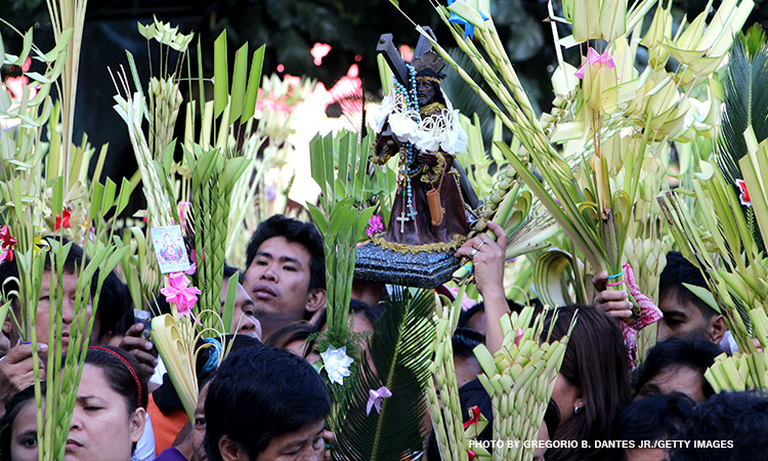
Holy Week begins with Palm Sunday and it is the Sunday with the greatest number of Sunday church-goers.
In this parish, there is the cenáculo, which runs the whole week, during which even the busy street of Evangelista is closed.
On Good Friday, the parish’s youth stage a live way of the cross along the streets. And above all else, people come in droves to the sacrament of confession since all parishes organize Kumpisalang Bayan, where many priests come together to hear the confessions of the faithful.
I studied in Rome from 1982 to 1987. Basically, Holy Week there is celebrated as we do in the Philippines. But we have more traditions which do not exist abroad:
Bisita Iglesiya, where the faithful visit 7 or 14 churches as they make the way of the cross,
Cenáculo, which is the dramatization of the life of Jesus especially his passion and death
Pabasa, where the History of Salvation is sung uninterruptedly using different tones, culminating in the suffering and death of Jesus
Salubong, which is the meeting of the resurrected Christ and His sorrowing mother Mary as the angels sing Gloria
Siyete Palabras, held during the midday of Good Friday, where the seven last words of Jesus on the cross are the topic of different speakers
The procession of the Santo Entierro, which is the statue of the dead Jesus and is done right after the Veneration of the Cross on Good Friday.
In some places, there are faithful who scourge themselves in penance and even allow themselves to be crucified on Good Friday
Watch: Penitential Walk: A Holy Week sacrifice
The peripheries
The poor find a great identification with the Black Nazarene of Quiapo Church. In fact the church is jam-packed not only on Holy Week, but all throughout the year — especially every Friday when devotees flock to the church.
I see in these celebrations a remembrance of Christ who suffered for our sins. I see in these street children and the people who are marginalized, they are an image of Christ, who continues to suffer because of the sin of injustice, corruption, and the abuse of the wealthy and powerful. The same thing happened to Christ two thousand years ago. And it still continues today.
I pray that the Holy Week could open our eyes not only to the suffering of Christ for our sins. I pray we may be more aware of the sufferings of the marginalized due to our neglect of those most in need. Because of this, I visit about five families in our parish every day, especially those among the poorest, as we are a very poor parish.
Beyond suffering
What we should learn as a people from our observance of the death and resurrection of Christ is that beyond our suffering and difficulties, there is always resurrection. But this is possible only if we accept our suffering as Christ did, for the good of others. That we should not think only of ourselves but those who are suffering since Christ is suffering in them.
Without the cross, there is no resurrection
Saints are our models of how they were able to live the death and resurrection of Christ in their lives.
This year, on August 16, we are celebrating the 200th birthday of St. John Bosco. He had a great career in front of him, which included being a bishop. He could well have become a cardinal or pope during his time. But he gave this up to take care of poor youth and started a congregation to dedicate to the poor youth.
The fruit of this sacrifice is the continuing work of the Salesians of Don Bosco for poor youth.
As it happened in the life of Jesus, all the saints show us that without the cross, there is no resurrection.
St. John Bosco was threatened countless times in his work of propagating the faith through good literature. Some priests of his time thought of him to be a lunatic since he was “wasting” his time with the street children.
There was even a plot among the other priests to bring him to the mental hospital. He was deserted countless of times by his supporters and was maligned. All these he bore and suffered for the sake of obeying to the call to serve the poor youth.
Related: Responsorial Psalm guy talks about life in the seminary
Continuous reality
Holy Week is a continuous reality in the Philippines — Jesus suffered in the hands of the powerful, and the poor of today suffer in the hands of the corrupt and those who abuse their authority.
I hope and pray that people in position, who can make decisions and are in authority realize the great responsibility. They have the capacity to change the lives of people and stop their suffering. I hope they also realize that they are responsible for the sufferings of the Filipino people, just like the pharisees or Roman soldiers who are responsible for the suffering of Jesus.
The economic growth of the country is a fairy tale for the great majority of people who continue to live in slums and inhuman conditions. The sad reality is that like the Pharisees and Roman soldiers, they do not see anything wrong in what they are doing.
I take the train and MRT. I admire the people who are daily suffering the traffic on roads, if not the long lines and pushing in the train coaches. I really wish that the executives in the government in charge of these utilities should take those rides every day.
Unquestionable faith
I believe that the reason why the Holy Week is very much felt in the Philippines is the deep faith of the Filipino people. Thank God, the Catholic faith was planted here 500 years ago.
I believe whatever faith would have been here would have been whole heartedly embraced by the Filipinos, as we are very spiritual.
An article I read in a newspaper was talking about the corruption in the Philippines despite it being predominantly Catholic. The author was talking about corruption among the people in position in government.
But as I go and meet the people in their homes, I see a lot of faith and even charity. I see mothers and fathers doing all they can to support their children to a better future. I see parents going abroad against their will just that their family will change for the better.
I see also Filipinos abroad bringing the faith wherever they go. They have started Simbang Gabi and procession of the Santo Niño in parishes abroad.
My sister in the U.S. and other Filipinos abroad can attest to that. They are leaders in the parishes especially among the choirs. They say that there are two things which characterize a Filipino: “faith and music.”
I believe it is also our greatest gift to the world: our “faith and music.”
One cannot question the faith of those millions who came to pray fervently in the rain as Pope Francis came. These millions will be in their parishes celebrating the mysteries of Holy Week.