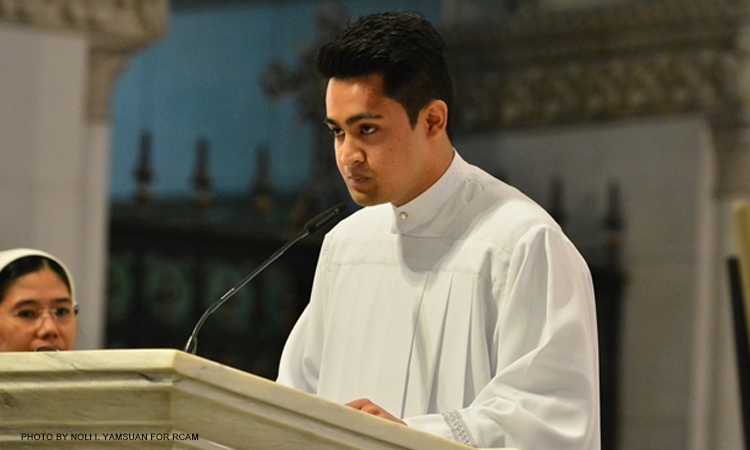

(CNN Philippines) — With hair neatly coiffed, a book tucked under his arm, and the black pullover-and-jeans combo he donned emanating a subtle cool, Kenneth Rey Parsad looked every bit the 22-year-old he is as he waited patiently in front of the Santisimo Rosario Chapel at the University of Santo Tomas (UST).
He stood beside the Martyrs’ Carillon under the shade of a nearby tree — curiously, his umbrella hung from one of its branches.
It was obvious that the spot was familiar to Parsad. And why wouldn’t it be?
After all, UST has been his home for about seven years now.
Parsad has been in the seminary for 11 years.
“That’s practically half of my life. You can just imagine how the seminary has altered my life,” Parsad said.
Parsad, who is half Filipino and half Indian, made waves on social media during the Papal Visit last January. As he sang the Responsorial Psalm at the Mass celebrated by Pope Francis at the Manila Cathedral, netizens were quick to notice the Abra native’s musical ability and good looks.
“It was a blessing for me because you don’t get to meet the pope often. About seven years ago, I was looking at a picture of Pope John Paul II when he held mass here and I wondered what it was like to be able to serve the pope,” said Parsad, who will be graduating with a Bachelor’s Degree in Theology this May.
While thankful for the praise and the kind words he received that day, Parsad said that, more than anything, he was grateful for the spiritual experience he gained.
For Kenneth, an authentic spiritual life is what matters most — and this is what he continually works on in the seminary.
“I am into the faith. I am passionate about the faith, the Christian faith, the Catholic faith. I love theology,” said Parsad, who entered the seminary in high school and is hoping to pursue further studies on scriptures.
After he finished minor seminary in his hometown, Bangued, Parsad found himself taking up Philosophy at the UST Central Seminary, where “centralites,” as they’re called, from various dioceses, study.
He was one of those who represented the Diocese of Bangued.
Life in the seminary
“Everyday life in the seminary is structured. There is a time for everything,” Parsad explained.
From the moment they rise at 5:45 a.m. to lights out at 10 p.m., a typical day in Theology school starts and ends with prayer.
Seminarians hear mass, engage in lauds (morning praise), pray the rosary, and go through the rite of benediction and exposition daily.
Prayers in the morning, in the evening, and at night are never forgotten and are said as a community.

“That’s the gist of the seminary formation — community life. That’s based on the Bible: Acts 2:42. The first Christians, they did everything together from prayers to eating. You’ll observe the same thing in the seminary ,” Parsad said.
Even studying has its designated time and is often done in groups.
Still normal
Although Parsad admitted that pursuing priesthood is “quite different” and that seminarians “are set apart for a certain call,” he noted that they’re just like other people — they still do “normal” things.
They might not have experienced junior-senior (JS) prom, their Valentine’s Days are usually spent with brothers in the seminary, and they might not receive salaries, but they are allowed to have and use Facebook, Twitter, and Instagram.
They have assigned chores within the seminary, just like in any home. They spend time hanging out with friends, too.
In fact, before the interview with CNN Philippines, Parsad came from the mall, where he checked out materials for light reading — a habit that was instilled in him by his mother.
“In the UST Central Seminary, there is the principle of responsible freedom: It can either make you or break you,” he said.
Because they are encouraged to practice responsible freedom, Parsad and his fellow theologians also have ample to time to ripen other skills and to pursue personal hobbies.
Although his love for books developed at an early age — at a time when he would describe himself as a “scrawny, little kid” with lots of antics — Parsad attributed his interest in basketball to his stay in the minor seminary, where formation was far more rigid.
He added that his talent in singing and guitar-playing were also developed in UST.

“The seminary will not hinder you from developing your talents. That’s why there are many talented seminarians. They will help hone your skills,” Parsad said.
Great responsibility
But Parsad acknowledged that this freedom demanded great responsibility and self-discipline. He lives by the mantra “Not all that you want is right.”
“We are not angels, we are not robots. We feel the same emotions, the same things that you do. We get hurt, we also love. But it’s how we deal with these things — that’s where the difference lies,” Parsad said.
When it comes to all aspects of being human, he said that as a seminarian, all life choices should boil down to spiritual stability and knowing who your are and what your calling is.
Parsad also shared one of the biggest struggles of seminary life — achieving an authentic prayer life.
“This is my personal take on it. I don’t know what others will tell you,” he said. “For me, prayer is not just supplicatory. It is more that just reciting the patterned prayers. How can you say authentic prayers? How will you authentically say that you are in a relationship with God?”
Now that his entry into the priesthood is only two years away — the age requirement for ordination is 24 — Parsad revealed that the plan that God has for him is, in some ways, still not as clear as he would want it to be.
But he stressed that his stay in the seminary has prepared him for a life dedicated to God and has taught him two important lessons.
First: “What matters most is your relationship with God — and when I say God, I also mean His Church.”
Second: “He is a God that both rejoices and suffers with you.”
“It [the seminary] has helped me to deal with people,” he said. “To bring God to the people, that’s the most special thing about the seminary.”
Spending most of a lifetime in one institution and dedicating yourself to the faith is certainly something you think through, but when asked if he would do it all over again, Parsad, without blinking an eye, said yes — even if it still meant no JS prom.